Chapter 1 (Continued): The Life of Joe Cowell (1792-1863)
Part Two: Joe Cowell in America (1821-43)
The Park Theatre, New York 1821
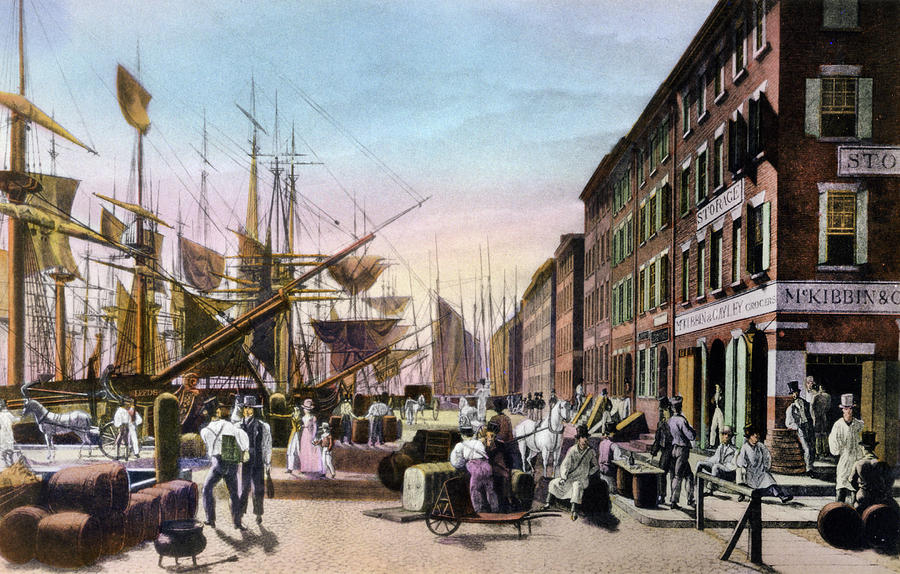
Joseph Cowell and his young wife sailed the Atlantic for approximately six weeks. It would be another decade or more before steam ships became the predominant means of transatlantic travel, halving the length of journey. Cowell outlines their modest on-board accommodation:
“There were two horsehair sofas on either side of a table, twelve berths with red curtains and sea-sick yellow fringe, and properly four staterooms forward of the mizen mast, one of which Price [the manager of the Park Theatre, New York] had engaged for myself and Mrs. Cowell, and the one next to it was used as a pantry.”
There appear to have been just six other passengers, four men and a woman accompanying her young child to meet his father for the first time in America. Cowell is not specific on this point, but The Thames was probably a cargo vessel, perhaps carrying transatlantic mail, something that was in great demand at this time. Of the four male passengers, Cowell struck up a lasting friendship with two: the part-owner of the vessel, a man called Scovill, and a black Jamaican actor called John Kent, also employed by the Park Theatre, with whom he would come to share lodgings. Sadly, he recounts the death of the child before the ship embarked, whereupon he was “hurried to the burial ground at Deal.”
After a “tedious and most boisterous passage” which at one point seems nearly to have resulted in a shipwreck, The Thames sighted land on 23 October 1821. Whether caught in the doldrums, or awaiting a safe entry to the harbour, the ship was obliged to anchor offshore overnight. Cowell and Scovill were both impatient to reach the city, and so gained the captain’s permission to take a rowboat ashore. It took them four hours, landing first at Staten Island, then by way of a steamboat ferry to the Battery, where Scovill accompanied him to the ship’s company counting house.
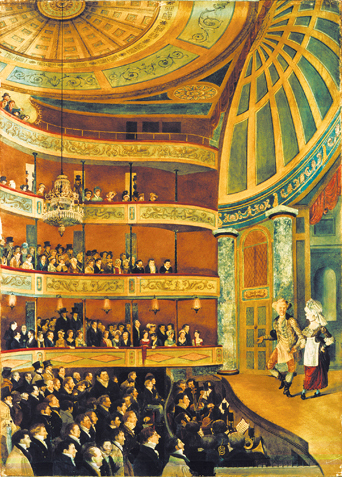
From there Cowell was escorted by a porter to the Park Theatre in Manhattan. Here he was greeted by the theatre manager Stephen Price, but by the time he’d arrived, rehearsals had already finished, and so the cast were not present for Cowell to introduce himself. When Price proceeded to offer dinner, Cowell politely declined on the expectation that he would dine with his travelling companion, Scovill. However, on returning to the counting house, no such invitation was forthcoming, much to Cowell’s dismay. The poor young English comic actor found himself alone and friendless on his first night in New York. He proceeded to wander the streets, later offering up a vivid account of the city:
“New York was then a very different place of accommodation for travellers from what it is at the present day; [He is writing in 1843] no oyster-sellers that you could tumble into at every corner, ‘restaurat’ [sic] staring you in the face in every street. […] After wandering about I knew not whither, oppressed with two weak evils, fatigue and hunger, I entered what in London would be called a chandler’s shop, put some money on the counter and inquired if they would sell me for that coin some bread and butter and a tempting red herring or two, I saw in the barrel at the door.”
Unfortunately for Cowell, the shopkeeper rather haughtily declined to take English money. American sensitivities still rankled it seems in the wake of the Revolution and of the War of 1812 with Great Britain. Cowell remarks of the occasion: “their [Americans] hatred of an Englishman they took pride in showing whenever in their power.” All the more ironic, then, when we come to discover that the English actor was paradoxically so ubiquitous and seemingly popular on that side of the Atlantic. But then Cowell makes the following conciliatory observation:
“[…] it must be conceded, a war there, or in any monarchical government, creates very different feelings (if any at all) from the ‘one spirit’ which actuates a free and sovereign people, whose lives, whose fortunes, whose sacred honour were pledged by their fathers to defend their homes and their liberty, and who with one accord exclaim ‘United we stand, divided we fall’”.
Whenever called upon, it seems Cowell was ready to take the liberal, Whig side of any political argument. Even given the initial difficulties he faced in New York; one has the sense that he was beginning to feel at home, and indeed he would come to spend the next twenty years in America.
However, on that first inauspicious evening, his next turning led him into Broadway, even then the entertainment centre of the city. Here he was able to exchange his English coins for hard American dollars and, returning once more to the “chandler’s shop”, availed himself of a meal of herrings “at the foot of Wall-street”. He then continued on his way back to the Park Theatre, where his vivid account bears testimony to the rudimentary, almost primitive state of American theatre at the time.
“Thus relieved in mind and body, I sallied forth up Wall-street and through Broadway. The pavement was horrible and the sidewalks, partly brick and partly flagstones of all shapes, put together as nearly as their untrimmed forms would permit. […] The exterior of the theatre [The Park] was the most prison-like looking place I had ever seen appropriated to such a purpose. […] Observing the front doors open I ventured in, and opening one of the boxes, endeavoured to take a peek at the interior of the shrine at which I was either to be accepted or sacrificed; but coming immediately out of the daylight, all was dark as Erebus.”
Stumbling down some steps and onto the stage, he finds himself brusquely manhandled by a burly stagehand who immediately ushers him out of the building and into an “alley knee deep with filth the whole width of the theatre.”
After wandering aimlessly a while, he returned later that same evening to witness a performance of Lionel and Clarissa, an operetta of 1768 by the English composer Charles Dibdin and librettist Isaac Bickerstaffe, itself further testimony to the ubiquity of imported English theatre at the time. However, he estimates that there were just twenty people in the audience, the theatre being very poorly lit by a dozen or so brass oil lamps. The leading male player he simply refers to as Phillips, an actor otherwise lost to historical record. The leading actress, however was Mrs Amelia Holman (1789-1833) who would marry Charles Gilfert, the celebrated impresario of whom much more would be heard over the ensuing years. Mrs Holman was regarded by many contemporary critics as the first star of American theatre and, like Madame Vestris, would later take up management. In the supporting, low comedian’s role of Jessamy was Edmund Shaw Simpson (1784-1848), yet another English-born actor. He had made his debut at the Park Theatre in 1809 at the age of 25 and established himself to become Stephen Price’s managerial assistant. In due course, Simpson would become a firm friend, but on that particular night, Cowell left the theatre distinctly unimpressed by the performances he had witnessed, “fully satisfied that I had nothing to fear.”
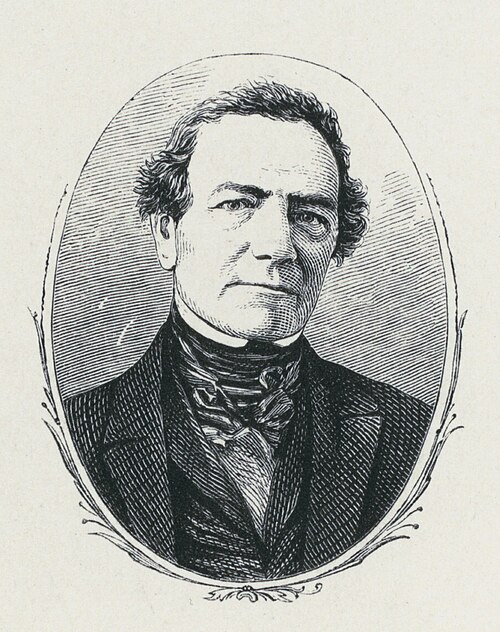
That first evening, Cowell then proceeded to retrace his steps back to Wall Street, where earlier he had eaten. It was just eight o’clock, but the streets were already dimly lit and largely empty. It would be another two hours before The Thames came fully into harbour with his wife and compatriots on board; so he again took some refreshment, and in his naturally gregarious and generous manner, he “treated ‘like a man’ to two or three rounds of grog and cigars” the handful of other customers who were in the bar. Being his first ever taste of tobacco and having refrained from alcohol for the entire transatlantic voyage, he quickly succumbed to its effects. Falling helplessly drunk and sick, he was promptly robbed by these new acquaintances of his “hat, cravat, watch, snuffbox, handkerchief, and the balance of the dirty [sic] dollars”.
“My incapacity to make resistance saved my coat [especially made for him in honour of Queen Caroline’s death, another indication of his liberal, Whig leanings], for I was so limber they couldn’t get it off whole, and after, in their endeavours, splitting it down the back and the tail being in a precious pickle, they concluded it would be more honourable to let me keep it – carried me down to a boat, rowed me off to the ship, and delivered me […] as ‘a gentleman very unwell’.
The following day, once the ship finally got into berth, Joseph and Maria Cowell drove to their new lodgings on the corner of Greenwich and Dey Streets. Price had booked them into an apartment with an English landlady, thinking it might be more conducive to their taste, though it was probably also cheaper to hire. After two weeks of “starving with cold and hunger” Mr and Mrs Cowell moved out of this ramshackle establishment to “a plain, honest Yankee woman’s – Mrs Gantley.” There they remained until Mrs Cowell secured a house in New Jersey which she occupied, soon to be joined by their two boys, Joseph and Samuel, who by then had made the Atlantic crossing to join them.
During his first season at the Park Theatre, Cowell was cast in a number of lead comic roles, including Acres in The Rivals and William in Rosina, as well as reprising his standard portrayals of Crack in The Turnpike Gate and Goldfinch in The Road to Ruinby Thomas Holcroft once again a very ‘English’ repertoire. Furthermore, despite being New York’s, and probably America’s, most well-established and prestigious theatre, the Park Theatre company was largely made up of English players. These included a comedian referred to merely as ‘Old Jack’ Barnes or John Barnes ((1761-1841) with whom Cowell had previously worked at the Plymouth Theatre Royal, and Thomas Albthorpe Cooper (1776-1841), the previous lessee and actor-manager of the Park Theatre.
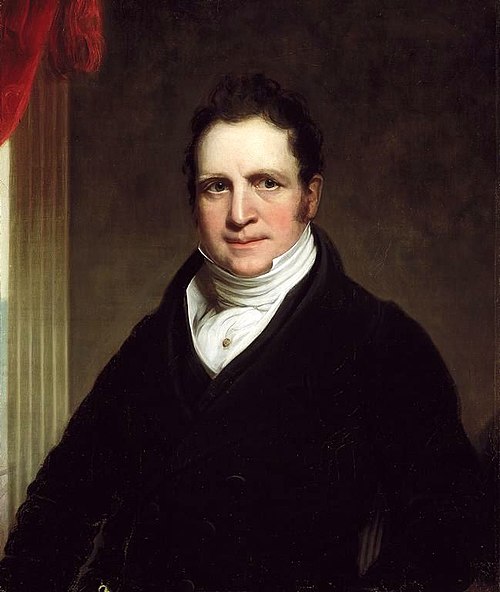
When Cooper once again succeeded Phillips as principal actor, Cowell appears to have taken an initial dislike to his bullying nature, “most disagreeable […] to all the mortals beneath him”. His superior manner may have owed something to having previously been manager, but also to his theatrical pedigree. Cooper was the adopted son of the playwright, Thomas Holcroft, and his daughter Priscilla was married to the eldest son of the future President of the United States, John Tyler. Clearly, in America at least, the social status of the actor was beginning to rise. In time, however, their relationship warmed, and Cowell became a frequent visitor to Cooper’s home in Bristol, Pennsylvania.
The preponderance of English actors in America could at times give rise to resentment among the indigenous public. But there was undoubtedly a taste and a market for such players. Cowell observes that even lesser talents might draw a crowd by emphasising their credentials in the publicity as formerly of ‘T.R.C.G’ (Theatre Royal Covent Garden) or ‘T.R.D.L.’ (Theatre Royal Drury Lane). Cowell himself was “underlined ‘from Drury Lane’” on his debut performance. In explanation, he rather self-deprecatingly makes the point that there were not “a sufficient number of American actors on the whole continent to form a company; fortunately for the young population of that day, they had something better to do.” But it is impossible not to infer that Americans of the time had, and for a long time afterwards retained, perhaps even to this day, a lingering inferiority complex when it came to matters theatrical, particularly when it came to the classical repertoire.
The cast were worked hard at the Park Theatre, playing every night without a break. The season began on 1 September and concluded on 4 July, at which point players were advised to seek summer engagements outside New York. Price recommended Cowell to take up an engagement in Boston, but he declined, believing himself not yet well enough established to take the risk.
Instead, he remained in the city, deciding to utilize his artistic skill and experience, free of charge, to redecorate the theatre and refashion its stage scenery. His apprentice in this project was Henry Isherwood (1803-1885) who would later establish his own reputation as a stage designer on Broadway. Cowell comments:
“His [Isherwood’s] after success in his profession I have been much flattered by his attributing to my encouragement and instruction. […] Glass chandeliers were purchased to supply the place of the iron hoops; the proscenium was arched and raised; no expense was spared for material; and dressed in gray and gold, the next season the ‘Park’ assumed the responsible appearance it has maintained ever since.” Price went to England for recruits, and Simpson and the larger portion of the company into the country “to keep the flame from wasting by repose”.
Yellow Fever & A Second Marriage (1822)
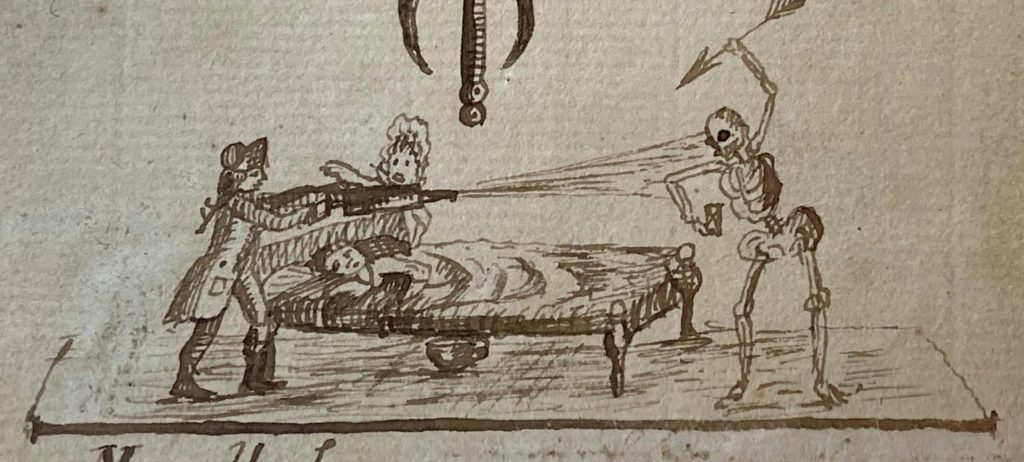
However, during that unusually warm August of 1822 an epidemic of yellow fever struck New York and “the panic became universal and frightfully ridiculous”. Those who could, abandoned the city. “In one hour”, he writes, “the thickly inhabited and largest portion of New York was deserted by every human being.”
Cowell’s wife and children were by now living at a safe distance in New Jersey, but he remained in his Manhattan lodgings, along with his colleague, John Kent, from the Park Theatre. This was the same John Kent with whom he had made the transatlantic crossing, and who, having been Jamaican born, “prided himself on being English” and thus the two struck up an immediate kinship. While aboard ship, Cowell had introduced Kent as an actor. However, whilst in New York, he is described as “a faithful old negro, who for years had been employed in the theatre as a sort of deputy property-maker.” Significantly, a black Jamaican could be employed on the professional stage in England as an actor – as in a few short years, so would Ira Aldridge and those other African American artists who followed him. However, in America, there was no such integration. The theatres, their casts and audiences were at this time strictly segregated – even in the so-called ‘Free State’ of New York.
Cowell went on to develop a lasting friendship with Kent, with whom he had set up a shared apartment which he describes as a “bachelor’s hall”. He recounts how, during the epidemic, they would twice a week venture forth from their sanctuary to feed the starving cats of the city. The following month, when both the fever and the resultant panic began to subside and New Yorkers were slowly returning, the Park Theatre immediately benefited. Cowell recalls: “the inhabitants then attended the theatre from the fact of there being nowhere else to go; even most of the churches were shut up.”
Cowell constantly emphasises that his memoir is a professional, not a personal one. As such, the precise facts pertaining to his private life are scant and one is left to infer many of the details. However, on 29 March 1823, scarcely eighteen months after his arrival in New York, his daughter, Sidney Frances Cowell was born. However, she was not Maria’s child, but that of his second wife, the actress Frances Cowell (née Sheppard). Neither of these events is referred to in Cowell’s memoir, but clearly, he had already separated from his first wife, probably at some point in 1822.
Had she died? Did they divorce? Was Maria so disenchanted with New York and the privations of the epidemic that she decided to return to her parents in Edinburgh? They were, after all, extremely well-established in the theatrical profession in that city. Perhaps she sought to rekindle her own acting career.
It is purely conjecture on my part, but I suspect that Maria most probably died, perhaps a victim of the yellow fever. In the first place, their surviving children, Joseph Junior, William and Samuel, remained with their father in America. Samuel, having been born on 5th April 1820, just eighteen months before the family sailed for America, was just approaching three years old when his half-sister was born. Would Maria really have chosen to return to Edinburgh and thus abandon them at such a young age? In later life, Samuel appears to have benefitted greatly from his Scottish family connections with the Murrays and Kembles to further pursue his career in Edinburgh. Would this have been possible if family ties were so deeply strained and broken? On the other hand, one is led to recall Cowell’s somewhat terse comment that they had married “by accident”. And one might also speculate as to the effect that the death of their infant daughter in New York may have had on their relations.
Nevertheless, it must remain a matter of further research as to what precisely happened to Maria Cowell (née Murray) and how and when exactly Joseph Cowell came to meet and marry his second wife. However, for the purposes of our present biography, it is clear that from now on in our narrative, Joseph Cowell is accompanied not merely by his three young sons, but by a newly extended family, comprising a second wife and their baby daughter, Sidney Frances, of whom we shall later hear much more.
American Circus (1824-26)

On 4 July 1823, Cowell’s professional life also took an astonishing turn when he became manager of New York’s first home-based circus. It was another Englishman, John Bill Ricketts (1769-1802) who had first introduced the circus to the United States. In 1792, he had established the Art Pantheon and Amphitheatre in Philadelphia, and this transatlantic importation would continue to develop over the subsequent decades. By the 1820s, a yearly visit was being paid to New York by another English circus under the management of somebody Cowell refers to merely as “West”. Clearly, this rival entertainment drew a significant audience as Cowell states it was “to the serious injury of the theatre.” [i.e. The Park].
In response, Stephen Price and Edmund Simpson attempted to buy out their competitor. A ruse was hatched whereby Cowell conveyed to West’s circus management, the wholly fictitious intention of the Park proprietors to erect “a most splendid amphitheatre in Broadway, on the vacant lot where the Masonic Lodge now stands.” Cowell’s prior career at Astley’s may have played some part in this wholly erroneous scheme as “a model, somewhat after the plan of Astley’s was placed in the green room [of the Park]”. The whole episode illustrates the desperate skulduggery to which rival theatrical managements were prepared to resort to in order to gain a commercial advantage. Price even engaged a circus performer “to break two horses in a temporary ring, boarded round, in a lot on the alley at the back of the theatre.” The subterfuge appears to have worked.
“Simpson and Price […] purchased the buildings, lease, engagements, horses, wardrobe, scenery, and a prohibition against West again establishing a circus in the United States.”
Either West had called their bluff, or the Park proprietors had had a change of heart, for their ruse now turned into a reality and they were henceforth the proud owners of New York’s first home-based circus. West returned to England “with a handsome fortune.”
The circus was not unique in its use of animals. West’s own horses and riders had been employed at the Park Theatre in spectacular pageants entitled Timour the Tartar and The Siege of Belgrade;and astonishingly, Cowell makes reference to a “real elephant” being employed onstage in a knockabout farce called Tom and Jerry in an “unexpected hydraulic experiment”. In this fast-growing industry, commercial competition was intense, and an ever-increasing display of lavish spectacle was proving an effective means to draw a crowd. So, too was diversion and refreshment. When a Frenchman called Barriére set up a tent offering sweets and light orchestral music in Chatham Street, in the vicinity of the Park Theatre, Price initiated his own fire regulations to have the place closed down. However, by then Barriére had profited sufficiently to set about erecting a permanent establishment of his own that would in time become the Park’s biggest rival – the Chatham Theatre.
As Cowell made his transition to circus management, his place at the Park Theatre, was taken over by two comedians, Tom Hilson and Harry Placide, both of whom have since disappeared from history. Cowell ruminates:
“I now look back and laugh at the contradictory feelings I experienced the first day I walked through the aisle-like stable, to be introduced to the members of the circus, as their future manager; each stall occupied by a magnificent animal, knee-deep in unsoiled straw.”
Among his mainstream theatrical colleagues, he would now be regarded as a “horseshit and sawdust manager”, though he preferred the epithet, “director of an equestrian company”. Cowell was able to make much of his experience at Astley’s in London, which was held in very high regard as the first of its kind, and still the most prestigious, in the world. With the backing of Price and other creditors, he was immediately able to extend the size of the company and an early and distinguished visitor was the Marquis de Lafayette. When the circus went on tour it encompassed Boston, Philadelphia, Baltimore, Washington D.C., and Charleston. Cowell can surely be regarded as one of the founding fathers of American circus. He was now truly getting to know his adopted country, and it was in Charleston that he would shortly come to renew an old acquaintance with a former colleague from England – Edmund Kean.
In the winter of 1825-6, Joseph Cowell set sail from Baltimore for Charleston aboard The Orbit, under command of the appropriately named Captain Fish. The company was composed of “fifty-five souls, including musicians, artists and carpenters.” Cowell describes it thus:
“She was a fine, roomy vessel […]. We paid one thousand dollars for the use of her, furnishing our own bedding and provisions, and fitting up, at our own expense, the stables upon deck and the temporary berths and state rooms between.”
Thus, “on a fine, sunshiny [sic] Sabbath morning” in January 1826, Cowell and his newly acquired circus company set sail for Charleston, South Carolina. In fact, they were sailing into Cowell’s second, and probably worst experience of a shipwreck for, within days, The Orbit keeled over in a hurricane, resulting in the loss of their entire team of horses. Miraculously, it seems, the ship was then hauled “very nearly the right side upward” largely due to the efforts of the First Mate, “a capital sailor […] with something like the agility of a drunken monkey”. Cowell’s writing is amongst his most vivid in this chapter, and his lively description lends a Gothic and romantic tone to the narrative, no doubt consciously appealing to his readers in an age in which traveller’s tales and maritime tales were so popular.
Again, he is much less forthcoming about his personal life. He merely writes: “Alarm for my absence had divorced from the mind of my wife all terror for the real danger, and my children were too young to understand it”, failing to add that this was in fact a new wife and baby daughter. Fortunately, there seems to have been no serious injury or loss of life among the human passengers and crew. The loss of the horses, however – eighteen in all – posed a potentially devastating problem for a travelling circus. Fortunately, word of the shipwreck having preceded the ship’s arrival in Charleston, a certain General McClane, a member of Soth Carolina’s landed gentry, volunteered the loan of his own stable of horses, free of charge, and thus the circus was able to proceed on its southern tour.
Cowell and his family took lodgings at the Broad Street House, “an excellent hotel, considered the first in the city.” Some of his colleagues expressed surprise that this establishment should have been managed by an African American, a man named merely as “Jones”. However, for his part, Cowell, untypically for this era, seems relatively devoid of such sentiments. Indeed, he appears, throughout his life, to have mixed freely and on equal terms with black people whenever he encounters them – as in the case of his shared apartment in New York with the Jamaican actor, John Kent. Again, one can only speculate, but perhaps his teenage experience in the Caribbean as part of the Royal Navy anti-slavery blockade played some part in this.
The Charleston Theatre & Edmund Kean (1825)
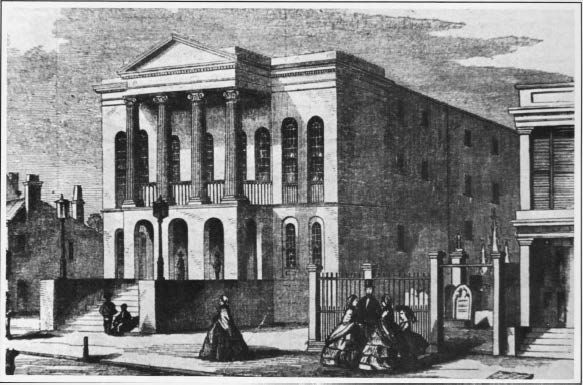
It had always been intended, as part of this excursion, to establish not only a circus, but also a mainstream drama company in Charleston. With that in mind, Price and Simpson at the Park Theatre in New York had engaged none other than Edmund Kean for a return visit to the United States with a view to introducing him to a southern audience.
Kean’s previous appearances in the United States had taken place during the years 1820 and 1821, exclusively in the northern states. Despite some friction with the press, those performances were regarded as a great success. However, in the intervening years, his private life in England had become embroiled in a notorious scandal, involving adultery with a married woman and a subsequent court case that resulted in £800 damages and separation from his wife. His reputation had plummeted, as had his general favour with London audiences and critics. Regarding his return to America, there were serious reservations and anxieties on his part as to how he might be received in the socially conservative former colonies, and in the event, his feelings proved justified. While awaiting Kean’s arrival in Charleston, Cowell recalls reading a newspaper account of “Kean’s having been driven from the stage in that city [Baltimore] and inquiring if, under the circumstances, his engagement had not better be cancelled.”
In fact, the southern tour proceeded, and the original plan followed through whereby the circus would perform in “a large building [that] had been erected for that purpose but without a stage”, while, on alternate nights, the mainstream dramatic company would perform in a theatre hired specifically for that purpose. This was the Charleston Theatre, also known as the Broad Street Theatre, for it was situated conveniently adjacent to Cowell’s hotel. At the time, this was in fact, Charleston’s only theatre. Built in 1794, following the repeal of South Carolina’s Vagrancy Act in 1787 (which had effectively banned theatrical performance), it catered to an audience of planter aristocracy, which though conservative, was both literate and sophisticated and, most importantly, anglophile.
The Charleston Theatre had previously been managed by the German American impresario, Charles Gilfert and his English wife Amelia Holman Gilfert whom Cowell had first encountered at the Park Theatre in New York. Cowell expresses his delight that they had left it “handsomely furnished.” In consequence, refitting the building was one less headache for him to deal with. This was a considerable relief in view of the fact that he was by now personally in debt to the tune of $3,000 with regard to the travelling expenses, salaries and accommodation for his fifty-five strong circus crew. A great deal, it seems would hang on the success or otherwise of Edmund Kean’s performances.
“But still”, writes Cowell, “the Eastern papers were torturing his offence [adultery] into a national insult, and calling on the chivalry of the South to avenge the wrongs this immoral play-actor had heaped upon the country!” Note the conflation of the actor’s private life with his stage persona, his ‘moral stature’ with his right to perform. Already, the actor as public figure, was taking on the patina of a ‘role-model’, a prurient emphasis on his or her perceived ‘moral’ behaviour, operating as a means to both inflate interest and simultaneously to denigrate the reputation of a ‘star’. This process could be dated back at least to the days of Nell Gwynne, and after her, to the likes of Mrs Siddons and Mrs Jordan. But with Edmund Kean and succeeding generations the vicarious scandal that would attach itself to the celebrity actor was reaching the apogee that it has largely maintained ever since.
Once the company had settled into its new surroundings, Edmund Kean was immediately dispatched from Baltimore, appropriately enough aboard a ship named Othello. After yet another harrowing voyage, (in fact the ship had even been reported as sunk in one of the local papers) Cowell recalls meeting his former colleague from Drury Lane appearing much enfeebled and sickly and deeply apprehensive of the engagements to come. “Cowell, for God’s sake”, he quotes him as pleading, “by the ties of old countrymen and friendship I entreat you not to let me play.”
However, there was far too much money riding on Kean’s performances to cancel now. And indeed, on one level, the advertising hype that surrounded his arrival had worked. His first night was played to a full house and seems to have passed off relatively well. “I never saw him play better”, writes Cowell, “at his entrance all was ‘hushed as midnight’.” Interestingly, he partially attributes this to the presence of “but one lady in the whole house [who] awed to respectful silence the predetermined turbulence of twelve hundred men!” One might take this audience imbalance and the corresponding ‘respect’ paid to the sole female attendee as yet further evidence of just how deeply conservative Southern society was. Cowell continues:
“Poor Kean was in ecstasies at his escape. The next morning nearly all the places were secured for Wednesday and a splendid houseful of ladies, as well as gentlemen, assembled to witness his masterpiece Othello [sic]. At his entrance, some ill-advised applause was instantly drowned in a shower of hisses; and in the early portion of the play, several sudden expressions of disapprobation occurred; and in the third act, at nearly the end of his fine scene with Iago, the storm so long pent up burst forth; some oranges, thrown on the stage, appeared to be the signal for a general tumult ‘of roaring, shrieking, howling, with strange and several noises’.”
The Charleston audience, however sophisticated, literate and gentrified, was, it seems, every bit as capable of pelting oranges as its London equivalent. In the ensuing mêlée, Cowell (according to his own testimony) had the presence of mind to draw the curtain and perform the most astonishing feat of his own devising. Rather than appeal to the audience with a direct address, he very cleverly enacted his own impromptu diversion. In strictest silence and with a certain mock dignity, he very slowly and painstakingly gathered the “atoms of oranges and apples”. He then gracefully bowed and departed the stage “amid thunders of applause”. His natural, understated comic instinct and talent had saved the day, winning over a churlish and fickle audience. Before the applause subsided, he was able to:
“[…] thrust Kean on with Desdemona […] and the same people who were, a minute before pelting him with rubbish, rose on their seats, and with ‘caps, hands, and tongues, applauded him to the clouds’ and the play proceeded with undisputed approbation!!”
The rest of the run was both financially and critically, a huge success. Kean was warmly welcomed into Charleston society, invited to dinner parties and various social functions. He himself received over £200 in remuneration while the overall profits “went far towards redeeming the pecuniary part of our [Cowell’s] losses”.
Unfortunately, it seems the rest of the Charleston drama company were not quite up to Kean’s standard. An actor called Charley Lee appearing as an officer alongside Kean’s King Lear, improvised his own lines and was generally, according to Cowell, more “valuable” and “excellent” when performing in the circus arena as a monkey. The actor (unnamed) playing the King to Kean’s Hamlet was a habitual drunk who shared the same tendency, deliberately undermining his role for cheap laughs. Despite this, Edmund Kean remained for the entire season, “delighted with the place and the people” before returning once more to New York in May 1826 aboard the ship Saluda. He was accompanied by Joseph Cowell, who, while once more being required to oversee the progress of the circus in New York, would also see his career take yet another dramatic turn.
Edmund Kean remained in New York until what would be his very last performance in America on 5 December that year. He then returned to London where he would once again rekindle some of his earlier popularity and success until his final performance at Covent Garden in March 1833. He died the following May.
The episode at Charleston Theatre underscores in the careers of both Cowell and Kean the extent to which the ‘star’ status of the actor was rising, while equally exemplifying the fragile structure upon which such ‘stardom’ was built. In this romantic, ‘heroic’ age, the actor, the Shakespearean actor in particular, was becoming increasingly tinged with the ‘stardust’ of the characters they portrayed and the intense, larger than life, focus on their performative, public role; literally the ‘limelight’ in which they were displayed. That this should be occurring in tandem with an increasingly commercialised theatre industry was no coincidence. The actor now had a public face as prominent as any politician’s or writer’s, any admiral’s or clergyman’s. But his profession had only recently been the sole preserve of either “rogues and vagabonds” or court entertainers, and in certain, strictly legal circumstances, it still was. So, to whatever celebrated, noble, wealthy or dignified heights the actor might ascend, his social rank remained tainted with that which was reprobate, illicit and taboo – the world of the strolling player, the tavern, the alehouse, the market square, the theatre.
This Janus-faced manifestation has, to some extent, persisted to this day. It still typifies the place of the actor in the modern world of entertainment. If anything, this aspect has become even more pronounced, in the intense, relentless and rarefied world of online social media. The hero as villain, the role-model as traitor, the Madonna as Magdalen, and most confoundingly of all, the actor conflated into the very character portrayed; and thus often, ironically, the better the actor, the greater the association with the part and the resultant confusion.
Edmund Kean was perhaps the first and most intense object of this double standard, this dual perception, this lionization with its accompanying demonization. And Cowell, in outlining the commercial development of his profession, provides an eloquent backdrop to the context in which this could happen. But he also sheds light on the personality of Kean himself, and the unique, revolutionary style he introduced onto the stage. He writes,
“The startling effect of his style of acting, boldly and suddenly setting at defiance the law and custom of the long-established school of which a Siddons and a Kemble were the models cannot be conceived at this day.”
Much has previously been written with regard to Kean’s shortness of stature, his somewhat wild and untypical appearance, and the peculiarities of his voice – not least by Cowell himself. However, that all of this should have seemed so unusual when he first erupted onto the stage in 1814, is as much a reflection of what preceded him as it is of his own genius. When Cowell uses the phrase “the law and custom of the long-established school” he is referring to a Classical Age of acting that favoured the well-spoken line, a declamatory style, in which a well-honed voice could recite the dialogue with clarity and precision. The focus, the meaning, the art, the emphasis was on the Word. The master of this style would have been David Garrick, who first raised such recitation to new professional heights. It was an approach that lent itself to much imitation, and it is interesting to note how often Cowell points out that in this era, one actor would deliberately set out to base his style on that of another – both in voice and manner. It was if an actor were trading on a certain brand, a franchise, a specific sound and body language, ‘the Kemble style’ for example.
Kean was of an altogether different age. His very insecurity and unpredicatbility were his metier. “Kean”, writes Cowell, “has set his soul and body on the action both.’” He was perhaps, in some sense, a Romantic precursor of the Stanislavsky/Method school of acting whereby one would place one’s actual self into the role portrayed. The emphasis here was not on the Word, but on the Emotion; and this was something for which Kean appears to have displayed an instinctive talent, though laced perhaps with an overarching flamboyance, an effusion of Gothic danger, menace and melodrama. From this distance in time and without recordings, we can only speculate, but whatever it was he did, it certainly seems to have worked and struck his contemporaries with force and originality. Cowell observes:
“His neglected early life had grafted habits on his nature totally at variance with his pure poetic taste […] and made him the contradictory and at times objectionable creature which, in general, he is exclusively described. The truth of the adage in his case was painfully proved: he knew not who was his father.”
A telling phrase indeed when we reflect on the obscuity of Cowell’s own origins. Interesting to speculate, is it not, how Cowell himself may have associated with this lack of a father figure. But again Cowell’s goes on to place his emphasis not on the personal, but on the professional – on how much an acting style, once set, attracts its imitators.
“[…] every aspirant to dramatic fame totters in the path his genius boldly trod. […] though he left behind no parallel to his excellence, he created a host of imitators, down to the third and fourth generation.”
One such imitator would be another of Cowell’s celebrated colleagues during the period of his return to the Park Theatre that summer of 1826.
A Return to the Park Theatre, New York, Junius Brutus Booth & a Host of Actresses (1826)
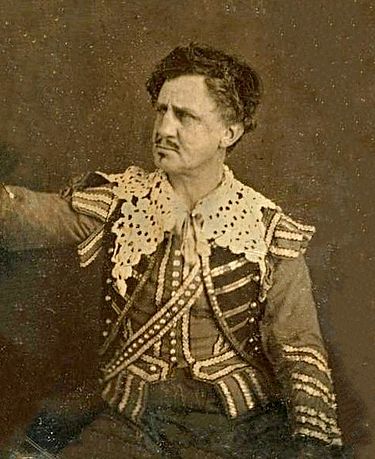
Such was his success at managing Kean’s season at the Charleston Theatre, that upon his return to New York, Cowell found himself offered co-managerial responsibility, in collaboration with Edmund Simpson, for the Park Theatre. At the same time, he also remained in overall charge – though not in a day-to-day, hands-on way – of the Charleston Theatre in Georgia. Not only this, but he also retained supervision of the management of the circus in New York. Soon he would be similarly active at the Chestnut Street and Walnut Street Theatres in Philadelphia, The Theatre in Washington City, and the Tremont Theatre in Boston. Over the ensuing period, Cowell would not only build a solid reputation as a reliable and astute actor-manager, but he can credibly lay serious claim to consideration as a founding father of American theatre, nurturing as he did both its very earliest establishments and its home-grown talents.
Regarding the Park Theatre in 1826, Cowell observes that “my company was extensive, and in many instances, it would compete with the best on the continent.” Among the stars that the theatre could boast of at this time was Junius Brutus Booth (1796-1852). Born in London, the son of a lawyer, Booth had emigrated to the United States in 1821 where he settled permanently, having bought a farm in Maryland and adopted American citizenship. “Though not a slavish imitator of Kean, “Cowell claims, he “founded his manner exclusively on his style.” However, in Booth’s case, the excessive idiosyncrasies of his personality seem to have bordered on genuine madness. Cowell goes on to observe that “everybody knew he was an oddity, and at times supposed to be insane. A sketch of his eccentricities alone would fill a volume.”
Not only did Booth routinely skip dialogue and even miss entire scenes, but he was capable of the most inexplicable behaviour. On one occasion, in the middle of a performance of Hamlet, he vacated the stage and climbed a ladder to the rigging, where he perched himself until rescued by the stage manager. Cowell also recounts how he almost got two perfectly innocent clergymen severely flogged for theft during a steamboat voyage, simply as a practical joke on account of his dislike of religion. As in bygone eras, the theatrical profession at this time was clearly a magnet to the outsider, the eccentric, the maverick, the misfit and in some cases, it would seem, the outright insane. His son, John Wilkes Booth, though less celebrated as an actor, would achieve longer lasting fame as the assassin of President Abraham Lincoln.
Among other cast members named by Cowell, we come across “William B. Jones and his lady”, and by surname only an actor named Young, and another named Roberts, “a capital comedian”. And then we discover a host of actresses: Mrs Tatnall, Mrs Williams, Mrs and Miss Pelby, Miss Virginia Monier, Mrs Parker, Mrs Robertson (aka Mrs Watkins Burroughs). Bearing in mind that the acceptance of female performers at this time dated back merely a century and a half to the Restoration period in England, there had been a veritable explosion of women into the profession – on both sides of the Atlantic. So, it is worth pausing a while to take on board Cowell’s observations on the rapidly expanding roles and status of the early nineteenth century actress.
In the first place, it strikes us how even the most pre-eminent of actresses were required to appear under their married names, or to make plain their marital status with either the title “Mrs” or “Miss”; this presumably, for the sake of ‘respectability’. In the case of a certain ‘Mrs Tatnall’ this raised some issues as she was “the lawfully wedded wife of five husbands”. English-born, her maiden name was Pritchard and her first husband named Pemberton, but upon marrying an American equestrian named Tatnall, she adopted his name for professional purposes. There followed a short-lived marriage to a “very inferior actor” named Hartwig, before she married into the medical family of Hosack in New York. This seems to have necessitated, for the sake of the family honour, that she resume her maiden name of Pritchard in the playbills. The death of this particular spouse was followed by marriage to another actor named Riley following whose demise she finally remained a widow. “Poor Mrs Tatnall!” writes Cowell, “she died at Texas a short time since [he writes in 1843] – that last resource for ‘talent struggling with despair and death’”. His appraisal of the theatrical merits of Mrs Tatnall seems to have outweighed those of Texas, for he concludes “she was really an excellent general actress.”
Mrs Tatnall, like many other actresses of the time, specialized in ‘breeches roles’ – that is, in male impersonation. For example, she played the lead role of Harry Clifton in an equestrian drama about a famous Sultan of Mysore entitled El Hyder. Following in the fashion set by Madame Vestris in London, the public display of a woman in male attire, not least in the highly revealing (for the period) deportment of tight male breeches and pantaloons, clearly pandered to a male sense of titillation, and quite possibly to a female sense of liberation. Cowell seems to have been happy to indulge this vogue when casting for his equestrian dramas at the New York circus.
He was less content it seems about the introduction onto the stage of another avenue for female talent – that of French dancing. It was the adventurous impresario Charles Gilfert, who had first established the Charleston Theatre, who led the way in this innovation at the Bowery in New York. Cowell observes:
“By comparison with what I had seen in Europe, they [the Bowery dancers] were of the fourth or fifth class in the way of talent; and the exposure of the persons of the females unexcused by elegance and grace, and the ribald remarks indulged in aloud, at the close of every pirouette by the gross-minded portion of the audience, rendered the performance most disgusting to the feelings of the virtuous and refined; while the poor half-undressed supernumerary women made for the first time in their lives, to stand upon one leg, bashfully tottering. [A] false taste which has taken the place of […] the legitimate drama […] and brought the stage to its present degraded position.”
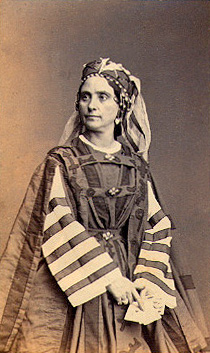
What had begun as suggestive titillation with the appearance of female artists in ‘breech roles’ was now developing into the introduction of a far more explicit and full-blown sexual exploitation. However, even among these rather sad-sounding dancers, there were those who stood out for their talent. One such was Céline Céleste-Elliott or Madame Céleste (1815 -1882). Cowell witnessed her debut performance at the Bowery in 1827 as part of Gilfert’s troupe and comments on her “native grace and modesty […] by comparison with those by whom she was surrounded.” Céleste went on to forge a considerable career in dance, mime and acting on both sides of the Atlantic.
Significantly too, many years later, in 1843, she came to share the management of the Theatre Royal, Liverpool with her lover and later the father of her children, Benjamin Nottingham Webster (1797-1882). Following their separation, she took sole control of two London theatres, first the Lyceum in the Strand and then the Olympia where she continued the tradition of Madame Vestris by appearing in travesty roles.
This movement into management represented another vital strand of female participation in the theatrical profession during this period. In addition to the already cited Elizabeth Satchell at Newcastle, Jane Marie Scott at the Sans Pareil (later Adelphi) and of course Madame Vestris at the Olympia in England, Cowell draws our attention to several such women in the United States. These included Amelia Holman Gilfert at the Charleston in Georgia and the Bowery in New York and Mrs Richardson at Mobile in Texas. He goes on to list the following: “Miss Cushman, Miss Maywood, Miss Virginia Monier, Miss Clarendon, [and] Mrs Sefton” with he observes “various claims to popularity” in the role.
As yet, there is little more information or documentation as regards where or how many of these women might have practiced what Cowell refers to as “petticoat government”, but clearly there was something of a sea change underway. Even in a relatively conservative society like the United States, and in particular, in the southern states, women were making headway both upon the stage, in their various roles, but also behind the scenes in business management and production. At the time, the theatrical profession may have provided one of the few avenues for such progress and arguably played a significant part in the advancement of women’s rights and opportunities, despite the considerable pitfalls, hardships, prejudices and exploitative practices to which they could also be subjected.
While Cowell had been absent in Georgia, a rival circus called The Lafayette had established itself on Grand Street in New York. This was under the management of none other than that same George Sandford, now appearing as General Sandford, whom he had previously known in Plymouth, England; that same American actor-manager who in 1812 had given Cowell his first entrée into the profession at the Dock Theatre.
As well as circus acrobatics, The Lafayette was presenting equestrian drama with the assistance of the British impresario Watkins Burroughs from the Surrey and Adelphi theatres in London. However, there simply wasn’t the audience to sustain two such establishments in the metropolis, and Cowell records that after two years, The Lafayette went bankrupt, closed down and finally burnt to the ground, never to be rebuilt.
For Cowell, Stephen Price continued to act as a talent scout and agent in London and as a result a steady stream of acts and actors were sent across the Atlantic to enhance both his dramatic and circus troupes. These included a bare-back horse rider named Hunter and a rope-vaulter called Stoker.
“[…] he, among a variety of liberties he took with himself, used to hang by the neck, not till he was dead, but just long enough to give his audience reason to believe that he might be.”
In all Cowell remained in charge of the New York circus for a period of three years from early 1824 until the winter of 1826, whereupon he ultimately calculated that he was no better off than if he had merely retained his position as a leading comic actor on the dramatic stage. So, upon receiving an offer to become actor-manager of the Chestnut Street Theatre in Philadelphia, he had little difficulty in accepting a return to his original occupation. By this time, and to make the decision even easier, the second Mrs Cowell and their children had already become resident in that same city. The day-to-day circus management in New York would henceforth be taken over by an assistant named Dinneford in partnership with a riding-master called Blythe and with Cowell and Edmund Simpson in overall charge.
The Chestnut Theatre, Philadelphia & The Nurturing of Native American Talent (1826)
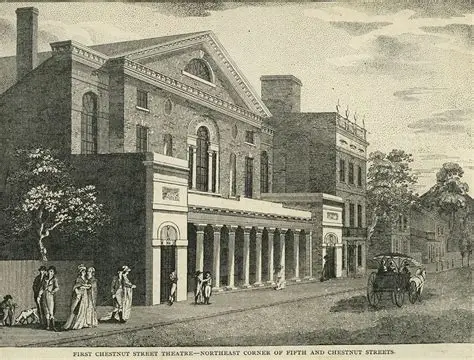
The offer of managership at the Chestnut Street Theatre came from William Warren (1767-1832) and William Wood (1779-1861), two veteran actor-managers who were then currently in charge. The former was English born, the latter a Canadian, and both excelled in comic acting. The theatre had originally been established in 1791 by yet another English actor-manager, Thomas Wignell (1753-1803), modelled on the Theatre Royal, Bath and Warren and Woods had taken over in 1798. It was they who had given the American, Edwin Forrest, his debut roles on the mainstream stage. Woods and Warren were now looking to retire from management, though they continued in the company, and it was to Joseph Cowell that they had decided to hand the reins, no doubt being familiar with the success he had already achieved in both New York and Charleston.
While surrendering their roles as managers, Wood and Warren would continue as actors in the company at Philadelphia. Wood, writes Cowell, “was a most mechanically correct actor”, his wife “a sterling actress”. Of Warren, he observes, he was “admired as an actor [who] had obtained a great reputation as Falstaff, which character his bulk admirably adapted him to represent.” The cast also included the low comedian, Joseph Jefferson (1774-1832). Born in Plymouth, England, he had migrated to America in 1795, first appearing in Boston as the character La Gloire in a play entitled The Surrender of Calais, an historical work of 1791 by the British playwright, George Colman the Younger. Interestingly, Cowell attributes Jefferson’s arrival in America as part of a troupe led by a man named “Powell”, whereas other sources1 attribute his appearance to a company led by the distinguished British actor-manager John Hodgkinson (1767-1805). Whoever may have been responsible for his being there, Jefferson certainly made the most of things, achieving great success and becoming one of the most popular comedians on the American circuit over the next quarter century. Cowell recalls of him, “literally born on the stage, he brought with him to this country [America] the experience of age with all the energy of youth.” And yet in older age his popularity was to wane as, “the same audience that had grown up laughing at him alone […] suddenly turned their smiles on foreign faces”; yet more evidence, that at this time, there was an increasing assertiveness in the American audience against British imports in favour of home-grown talent.
As a consequence of his declining popularity, Jefferson finally gave up on Philadelphia. Along with his wife and children, he formed a travelling company which, while based in Washington City, toured the minor towns of Pennsylvania, Maryland and Virginia. However, in his recollections of this family, Cowell once again underscores the hardships that could bedevil the itinerant theatrical life. Two of Jefferson’s daughters died in quick succession, while his “son-in-law, Sam Chapman, was thrown from a horse and the week following was in his grave.” Another of his actor sons, upon returning to England, died soon after in 1831; and within a year, both Jefferson and his wife were also deceased. However, from the ashes of this ill-fated touring company, there emerged something of a phoenix, a grandson, another Joseph Jefferson (1829-1905) who was to become “beyond question the most popular and respected American comedian of the nineteenth century.” 2
Overall, according to Cowell, his company at the Chestnut Theatre, Philadelphia, “if not eminent for talent in every department, was highly respectable.” Others among the cast were John Greene “a great hit” in Irish roles, and his wife “who can play the Queen in Hamlet better than anybody I saw in America”. Also worthy of note was William Pelby (1793-1850), another home-grown talent from Boston, Massachusetts, a tragedian who had made his name as Macbeth at another Philadelphia theatre, the Walnut Street. of him Cowell writes: “[He] was one of the first native American tragedians, that is who made a living exclusively on amor patriae capital.” In other words, the presence of Americans on stage (as opposed to imported talent) was becoming something of a sensitive, if not yet political, issue. Pelby would go on to forge a career as an actor-manager in Boston. His wife, Rosalie French Pelby (1793-1857), was another notable company member. A native New Yorker, this eclectic artist began her stage career aged twenty as a chorus singer before establishing a reputation in melodrama and straight acting. Later in life she would achieve great acclaim as a wax sculptor in California.
A fellow New Yorker in the company was John Jay Adams (1798 – 1839), a tragedian whose “Hamlet was recalled as one of the finest of his era”3 but whose career came to a premature end through over-indulgence in alcohol and general dissipation. And yet another home-grown talent was Charles Henry Eaton (1813-43), a Bostonian whose career again specialized in leading Shakespearean roles. He too fell victim to alcohol. As in so many instances cited by Cowell, the perils of alcohol were never far from the actor’s life. Of Eaton, Cowell observes:
“In addition to his giving a most excellent imitation of Booth’s acting, he assumed a most lamentable caricature of his [Booth’s] eccentricities off the stage. [His] second-hand vagaries were disgusting; his distorted fancies too, like other monstrosities, had to call in the aid of alcohol to perpetuate their first-conceived deformity. Poor fellow! He carried the joke too far at last and fell from a balcony at his hotel […] and died in (sic) a day or two afterward.”
Already in the 1820s, the balance in this Philadelphian theatre was clearly moving towards home-grown American talent and away from the conventional dependence on British imports. This was further enhanced by two more American born artists in the cast: Hetty Warren, daughter of his erstwhile colleague, William Warren and Elizabeth Jefferson, daughter of the comedian Joseph whose family encountered such tragedy as a travelling company. In their case, it was not so much the perils of alcohol, as of unhappy marriage and poverty that were at hand. Cowell recalls:
“Poor girls! They were both born and educated in affluence, and both lived to see their parents sink to the grave in comparative poverty. Hetty [‘s marriage] proved a sorry one [while] Elizabeth became the wife of Sam Chapman [who died] less than a year after her happy marriage.”
To enhance his company at the Chestnut Theatre, Cowell also “secured a galaxy of stars of the first magnitude.” Among these we may count William Charles Macready (1793-1873), Thomas Abthorpe Cooper (1776-1849) and Edwin Forrest (1806-72). Amidst this “galaxy”, he also cites two actresses, a Mrs Knight and Lydia Kelly, but sadly thus far, we have no further documentation in the historical record as regards these female artists, as seems so often the case.
Regarding Macready, however, Cowell records having seen him three times in London – once in Rob Roy and twice as the leading character Pescara in a piece entitled The Apostate by the Irish writer Richard Lalor Shiel (1791-1851). This was produced at the Theatre Royal, Covent Garden in 1817, and also featured Charles Kemble and Cowell’s erstwhile father-in-law Charles Murray in the cast. It says much of the pulling power both of Cowell as an impresario, but also of the United States in general, that such a rising star as Macready could be drawn away from London’s West End to play in Philadelphia. In 1827, at the age of thirty-four he was in his prime and could boast of success at both Covent Garden and Drury Lane. Unlike his account of Edmund Kean, Cowell makes no mention of Macready’s notoriously difficult personality or temper, but he does make the following observations:
“[His] arrival in this country may […] be said to have formed an epoch in the history of the American drama. […] This great practical example of the power of art over impulse was not lost upon [Edwin] Forrest [who] imitated the means by which such eminence had been attained.”
In other words, as Cowell saw it, Macready’s controlled but forceful style was a huge influence upon up-and-coming American actors such as Edwin Forrest, perhaps the first major home-grown talent. In 1848, some five years after Cowell’s departure from American shores, the rivalry between these two iconic actors would erupt into the Astor Riots in New York – the climactic expression of American resentment and hostility towards the British theatrical presence. During Cowell’s tenure in Philadelphia, however, such feelings were still largely suppressed and casts of mixed nationality able to collaborate on mutually respectful and equitable terms – but the balance was already shifting in the home-grown direction.
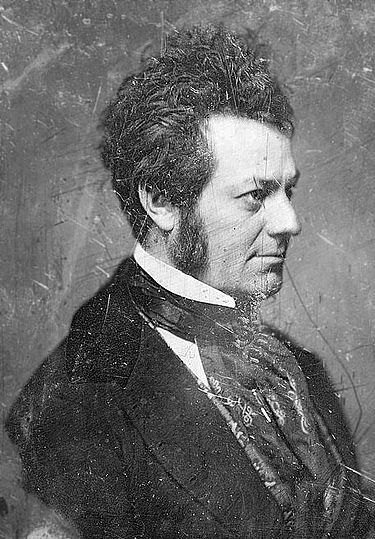
Edwin Forrest was an actor already familiar to Cowell from his period at the Park Theatre in New York, and according to Cowell:
“He possessed a fine, untaught face, and good manly figure, and, though unpolished in his deportment, his manners were frank and honest, and his uncultivated taste, speaking the language of truth and Nature, could be readily understood. […] Having had an opportunity of witnessing his unschooled efforts, I strongly urged his engagement at the Park.”
Do we detect a whiff of patronizing condescension here? What Cowell regards as “unpolished” and “unschooled” may have been merely a reflection of his using his native-born American accent, while injecting an original element of direct, ‘frontier’ storytelling. Forrest began his rise to fame under Charles Gilfert at the Bowery Theatre in New York and in that arena, much was made of his not being English, but his being a native son, “enlisting the prejudices of the Americans”. Along with the growth of American theatres, and talent, one senses an increasing outlet for national expression.
We have a great deal of documentation in the historical record pertaining to these male performers. However, it should be restated, for it is perhaps highly significant and revealing, just how often it is the female performers of this era who, while appearing with great favour and approbation in Cowell’s memoirs, have left little or no further trace. For Example, according to Cowell, “for attraction, none could compete with the brilliant Lydia Kelly; her extraordinary success must have astonished herself”. Unfortunately, we can only take his word for this since otherwise Lydia Kelly – unlike Macready or Booth or Forrest – has disappeared entirely from the record.
Goodbye to the Circus & Hello to the Walnut Street Theatre, Philadelphia (1827)
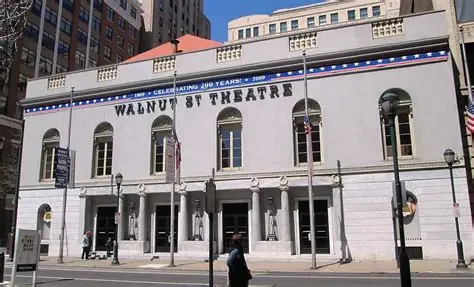
From his distant remove in Philadelphia, Cowell soon decided that the circus in New York, for which he had retained supervisory oversight, was falling into disarray. It was losing money; stockholders were selling out and the best of his performers had drifted away. With his typical mix of risk, ruthlessness, optimism and energy, he set about forming a new company to take its place. He secured the services of John Hallam [Who may be a member of the celebrated Anglo-American colonial theatrical family of Lewis Hallam. This requires further research if possible] who, returning from a trip to England, brought with him a host of players, most of whom were family members, including his wife and her sisters, Rachel Stannard and Mrs Mitchell and her husband, and also a certain Mrs Lane and Mrs Hunt.
To this cast list we should add Cowell’s “principal man, Grierson” who had created the role of Wellington in the equestrian drama The Battle of Waterloo at Astley’s in London; also a certain W.H. Smith who “became an immense favourite […] one of those pink-looking men with yellow hair that the ladies always admire […] the best fop and light comedian on the continent. I doubled his salary directly” ( Smith went on to write a record-breaking play called The Drunkard) and finally John Sefton, “a sort of failure; though very queer and excellent in little bits.”
Meanwhile, at the Chestnut Street Theatre in Philadelphia, William Warren had engaged the London born actor Francis Courtney Wemyss (1797-1859) to replace Cowell in the role of manager. He was a reliable ‘stock’ company player who could take on comic or dramatic roles and his would be a varied career, later taking on managerial roles in Baltimore and New York.
At this point, however, in September 1827, Cowell decided, quite suddenly, that the equestrian shows were losing business. He sent the circus once more out of New York to perform on tour in Wilmington, Delaware. He then opened with his new dramatic company at the Walnut Street Theatre in Philadelphia – on the site of what had formerly been the circus ring in that city. He would now be in direct competition with his former venue at Chestnut Street!
As though irked at being replaced at Chestnut Street, Cowell seems deliberately to add spice to this rivalry, because he then decided to perform the very same plays on the very same nights – Venice Preserv’d by Thomas Otway and The Young Widow by Thomas Overbury. Cowell gloats:
“The full tide of public opinion was in our favour. We could play three light pieces for a week in succession, to six and seven hundred dollars a night; when the Chestnut-street (sic) would prepare an expensive performance, or rather, display an expensive company to thirty persons.”
One wonders to what extent part of this turning of public opinion to his favour was as a result of employing more home-grown American talent. Cowell makes much of the fact that Wemyss at Chestnut Street employed more established and expensive actors from Britain than he was able to on his limited budget. However, another veteran star he was able to add to his ‘galaxy’ was indeed English, the London born Thomas Albthorpe Cooper. Having established his reputation in Covent Garden in the early 1790s, Cooper made his American debut at the Chestnut Theatre in Macbeth in 1796. He returned in 1804 and thenceforth adopted America as his home. His daughter Priscilla would go on to marry the eldest son of the future President of the United States, John Tyler. Cooper moved in distinguished circles, so it was quite a coup for Cowell that he should select the Walnut Street Theatre to give his farewell performance to an American audience “with whom he had been for so many years the idol”.
Holliday Street Theatre, Baltimore & The Washington Theatre (1827-28)
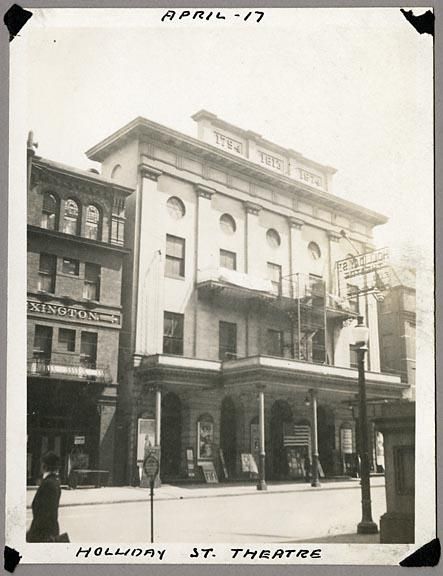
Now on something of a roll, and emboldened by his success in Philadelphia, Cowell then decided to take a lease on the Holliday Street Theatre in Baltimore. This had been established in 1794 by the English actor-manager Thomas Wignell (1753-1803) and his business partner, the American composer, Alexander Reinagle (1756-1809), where they specialized in opera and ballet. Warren and Wood’s had appeared on tour at this theatre over several years with what Cowell dismissively refers to as their “jog-trot company” from Chestnut Street and Baltimore had by then sunken to “the reputation of being the worst theatrical town in the Union.” He goes on to state:
“I had the house thoroughly repaired and decorated, the lobbies carpeted, and stoves erected there under the stage. The gallery, which had become an unprofitable nuisance, I dispensed with entirely, and made that entrance serve for the third tier, effectually separating the visiters (sic) to that section from the decorous part of the house.”
The training and experience in scene painting, stage management and building refurbishment that Cowell had gained over the years from Drury Lane to Brighton to the Park Theatre in New York was clearly coming in useful. So too were his many high-placed social connections as he was able to get a corporation tax of ten dollars per performance immediately halved. One may speculate whether Thomas Cooper’s direct line to the future President John Tyler played a hand in this. Cowell’s company opened at the Holliday Street Theatre in November 1827.
However, one actress of the time, who appeared with Cowell in Baltimore, has left a considerable legacy. Her name is Clara Fisher (1811-98). London born, she was a prodigy and child star from the age of six. She made her American debut at the Park Theatre in 1827 and in 1834 married the American dramatist James Gaspard Maeder (1809-76) whereupon she settled permanently in the United States. Clara Fisher displayed versatility in her roles, ranging from Ophelia to Lady Teazle. Of her Cowell writes:
Edmund Simpson, still based at the Park Theatre in New York, continued to send him a steady stream of talent. As well as Thomas Hamblin, Cowell was at various times joined in Baltimore by Edwin Forrest, and another home-grown star, the New Yorker, James Henry Hackett (1800-71) who specialized in Shakespearean comic roles. He brought a distinctive “Yankee characterization” to the parts4. There also came John Barnes (1761-1841) with whom Cowell had previously worked in England, and Horn and Pearman, referred to merely by their surnames, but again otherwise sadly lost to the record; and likewise, the female stars, Mrs Austin, Mrs Knight and Lydia Kelly.
“[..] the captivating Clara Fisher […] played with me for six weeks, to a succession of overflowing houses. Nothing could exceed the enthusiasm with which this most amiable creature was received everywhere. ‘Clara Fisher’ was the name given to everything it could possibly be applied to: ships steamboats, racehorses, mint-juleps, and negro babies.”
The final reference to “negro babies”reminds us that in Baltimore, Cowell’s company was performing in what was then still the slave state of Maine. However, the overall thrust of the account gives testimony to the power of theatrical ‘stardom’ even in this relatively early period. It was a power that managers and impresarios like Cowell could readily exploit to business advantage.
Riding high on these successes, Cowell next ventured into Washington City, the governmental capital of the nation, but at the time, still relatively backward as a cultural centre. He writes:
“Washington City could then only boast of a very small theatre in a very out of the way situation […] I immediately set a swarm of carpenters to work to bang out the backs of the boxes and extend the seats into the lobbies […] The plan succeeded to a nicety. Never had there been such a scramble before for places in the capital. […] At the end of two days every seat was secured for the whole of [Clara Fisher’s] engagement.”
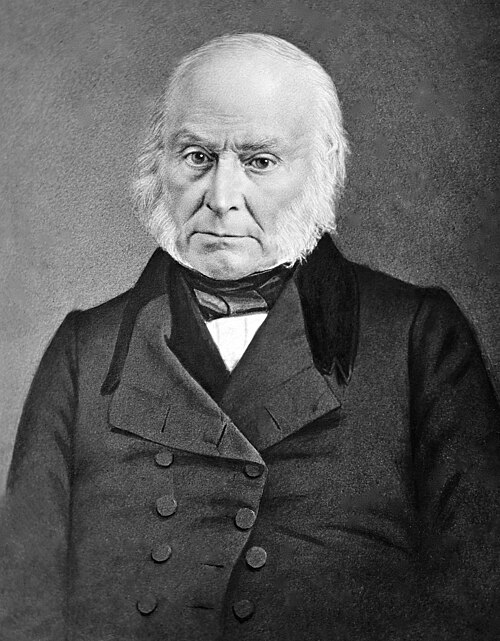
Even the President of the United States, John Quincy Adams (1767-1848), sent a request for a seat on opening night to “the Manager of the Theatre”; to which Cowell responded with regret that the President would have to wait five days such was the demand. Cowell addressed his reply to “the Manager of the United States”, much to Adams’ amusement.
Meanwhile, back at the Walnut Street Theatre in Philadelphia, such was his success that Cowell had been granted a lease of ten years. He set about designing overall improvements to the building – which had been used largely as a circus venue since 1822. The English architect John Haviland was engaged, and an entirely new building was erected within the edifice of the old. However, such was the enthusiasm – not to say mania – at the time for developing theatres and expanding the cultural life of America, that even as this project was underway, yet another theatre was proposed in nearby Arch Street. As a result, Cowell got cold feet, concluding, probably correctly, that Philadelphia could not sustain three such establishments.
The Tremont Theatre, Boston, a Talented Son, Sam Cowell & a Return to New York (1829)
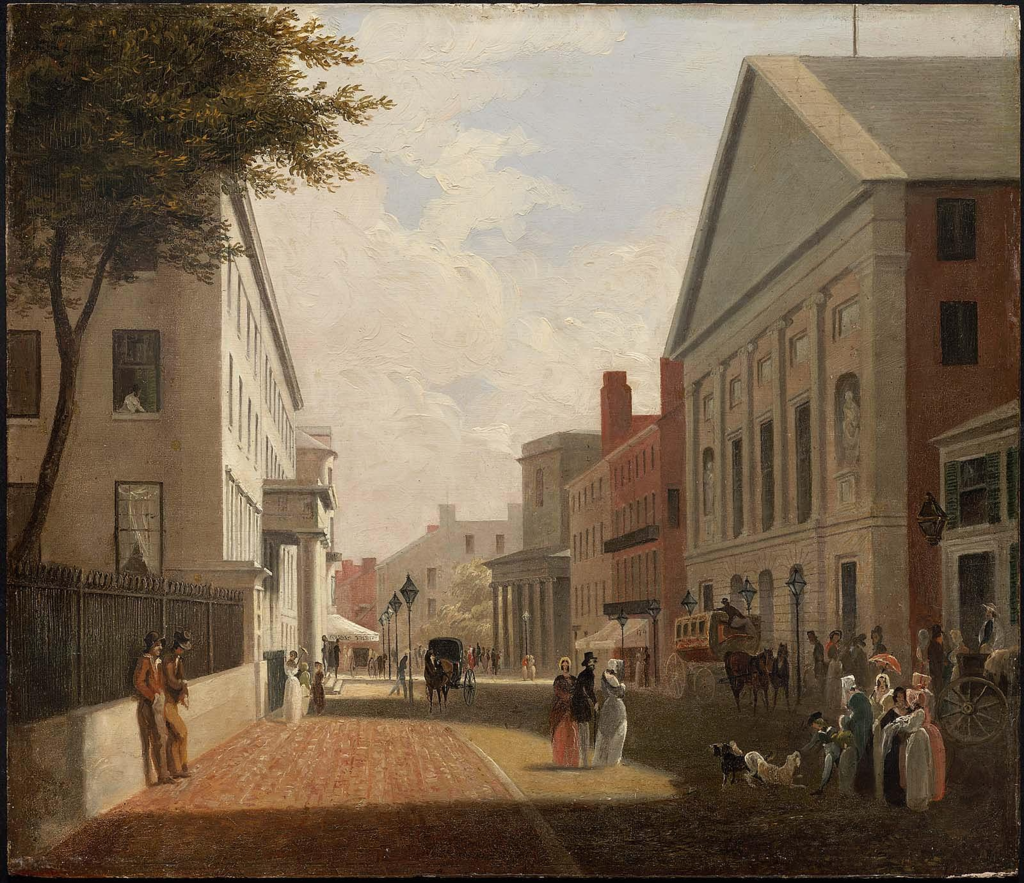
So, upon receiving the offer of managership at the Tremont Theatre in Boston, he hastily bailed out, a decision which later he claims to have “most heartily regretted.” Cowell’s engagement at the Tremont was for a period of forty weeks for a fee of four thousand, five hundred dollars. However, by the terms of the contract, he would have no say over a cast that had already been assembled, and his stage manager and leading player would be the irascible Junius Brutus Booth. “The arrangements at the Tremont Theatre”, writes Cowell, “were both costly and injudicious, and therefore though the season was a brilliant one, it was most unprofitable.”
The one positive from this engagement appears to have been the revelation that his youngest son, Samuel Cowell, had the talent to perfectly imitate his father in his signature role of Crack in The Turnpike Gate. That season of 1829 aged just nine years old, the young Cowell would make his stage debut at the Tremont in Boston performing just such an imitation during his father’s benefit show. However, Cowell senior makes it clear that he did not pressurize his son into the business. From Robert ‘Romeo’ Coates to Clara Fisher, he had seen firsthand “the consequences in after life of forcing precocious talent”. But here the seeds were sewn of the second generation of the Cowell dynasty, for Samuel would go on to foster a considerable career of his own – not least as an adolescent in the company of his father.
For the ensuing period, Joseph Cowell moved away from management altogether, and resumed his former lifestyle of the peripatetic comic actor. In the spring of 1829, once his contract at the Tremont had been fulfilled, Cowell took an engagement as the principal comedian under James Hackett at the Chatham Theatre in New York. But this proved to be unprofitable and lasted barely a month before he returned once more to Walnut Street in Philadelphia. Here he was able to earn twelve hundred dollars for a two- week engagement, mostly from a single benefit night. His next engagement was at a newly constructed amphitheatre on Front Street in Baltimore where he played five consecutive nights, earning nine hundred dollars. Shortly afterwards the building was burned to the ground with a horrendous loss of life. Though soon after rebuilt “as by far the most perfect building for such purposes now in the United States”, it would ultimately disappear in yet another conflagration, the Great Fire of 1904.
The Far West (1830-1843)
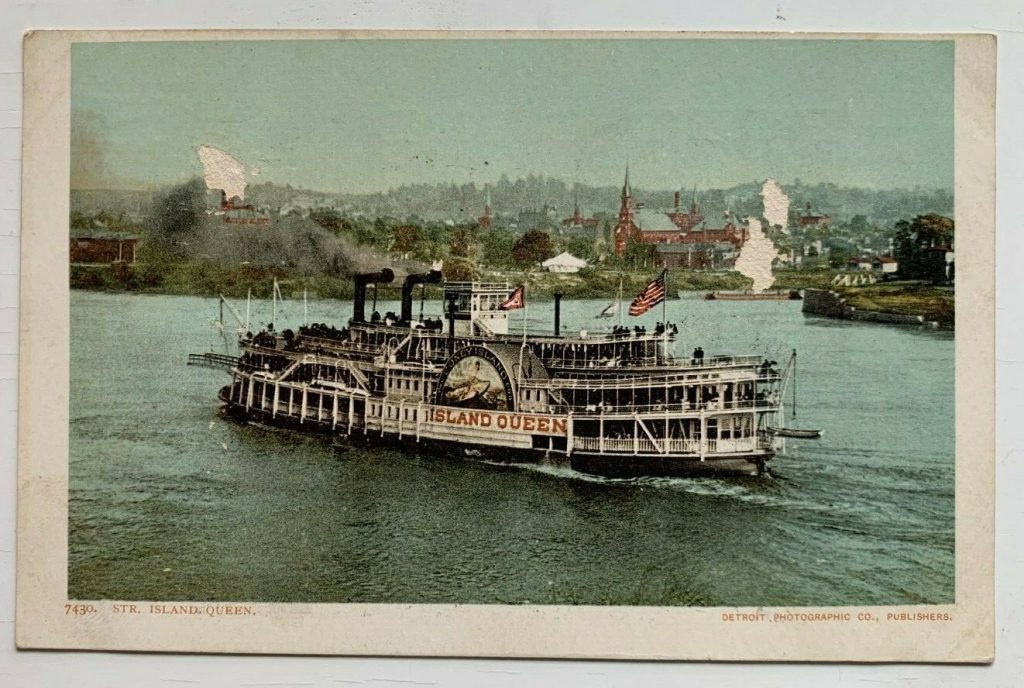
At this juncture, Cowell’s life would take yet another dramatic turn, for he was about to embark upon perhaps his greatest and most reckless adventure. He would take his chances as an actor in what was then the settler country of the Wild West and head for Ohio, Kentucky, Louisiana and Texas. He recalls:
“It was one o’clock in the morning, at the latter end of November, that my dear boy Sam and myself left Baltimore in a stage-coach and a snow-storm ; and in three days and two nights, through mud and mire, we arrived, as if by miracle at Wheeling, Virginia, where we fortunately found a little steamboat called the Potomac ready to start for Cincinnati.”
In all, Joseph and the nine-year-old Samuel travelled over five hundred miles by stagecoach and riverboat through some of the most rugged and barely explored terrain on the continent. He makes no mention, but it must be assumed that Mrs Cowell and their baby daughter, Sidney Frances, were ensconced at the family home in Philadelphia, while the two older boys, Joseph and William were already employed in their respective professions of scene painter and actor.
Cowell goes on to describe the Ohio River as “wild and dreary” populated by a few, sparse habitations along its banks and with sometimes “a group of dirty, loose, unattired women and children.” All the more surprising then that he could envisage in these uncultivated environs a potentially fertile ground for the likes of Shakespeare or Sheridan. However, he was not to be disappointed. Arriving in Cincinnati, which he considered the “Queen City of the West”, and booking into the nearest hotel, he immediately discovered, displayed on the wall of the bar, a playbill for a performance that very evening of The School for Scandal.
It should be borne in mind that Cincinnati had only seen its first European settlers in 1788, a group of 26 migrants from New Jersey and Pennsylvania under the leadership of Benjamin Stiles. By 1820, the population had grown to 10,000, its economy based on agriculture, fishing, hunting and most importantly transportation as a hub on the Ohio towards New Orleans and into the further western territories. It was still the roughest of frontier towns when Cowell first arrived. Nevertheless, in a makeshift theatre near the hotel bar, on his very first night, he attended a production of Sheridan’s satirical comedy. This was produced by a local actor-manager called Alexander Blake who was himself taking the part of Charles Surface. Cowell offers a vivid account of the performance:
“If he had never played the part before, he [Blake] had an extraordinary ‘swallow’ [memory], for he was perfect […] he was a low comedian and an excellent one. […] His wife was the Lady Teazle; […] I was not then accustomed to the pecular twang in the pronunciation of the west end of the United States, which, in consequence sounded uncouth and unlady-Teazle-like to me.”
This was Sheridan with little concession to English refinement; the Americans were already placing their own interpretations on the classical English repertoire and Cowell is generous enough to concede that Mrs Drake “got great applause”. The theatre itself was “a small brick building, well designed but wretchedly dark and disgustingly dirty”. Cowell estimates the audience at around one hundred, and again somewhat incongruously made up largely of “Swiss and German peasants, who then constituted a large portion of the population”. Who would have imagined that one could stage an eighteenth-century English comedy in a wild American frontier town to a German-speaking audience? If nothing else, it is surely testimony to the adaptability of the works of one Philip Brinsley Sheridan, and the intrepid optimism of Joseph Cowell. The mind boggles at what the local population of Native American Shawnee tribesmen may have made of this ritual, but here, however rudimentary, were the seeds of the entire American entertainment industry.
As a footnote to this event, Cowell records that at the end of the play “a tall, scrambling-looking man with a sepulchral falsetto voice” performed an English ballad entitled Giles Scroggin’s Ghost. This was none other than T.D. Rice who would go on to create a sensation and popularize a whole theatrical genre when he later performed his blackface minstrel act, Jump Jim Crow in New York and London. Clearly, by this time, Rice was already touring the Midwest and honing his craft.
As regards Alexander Drake’s drama company, it was in fact one with a considerable theatrical pedigree. His father, Samuel Bryant Drake (1768-1854) had been the actor-manager of a troupe of strolling players in the West of England. In 1810, he and his entire family had migrated to America where he established a reputation at Boston Federal Theatre before becoming actor-manager at John Bernard’s Theatre in Albany, New York State. When his wife died in 1814, the elder Blake embarked on a pioneering venture along the Ohio and Mississippi rivers, becoming a true trailblazer of theatre in the new territories. According to The Oxford Companion to American Theatre: “In many of the cities along the way, his was the first professional company ever to offer theatrical performances.”5
When Cowell arrived in Ohio, Drake Senior was currently based with another company in Frankfort, Kentucky. Meanwhile the Cincinnati company, under management of his son Alexander, was constituted of the succeeding generation, “all educated to sing, dance, fight combats, paint scenes, play the fiddle and everything else” in the tradition of medieval and early modern English players. Gradually, however, the Midwest had attracted an influx of skilful artisans from the older States and the European continent, one more educated and enlightened than the earliest settlers. A taste for ‘higher’ culture was developing. “New towns must have new theatres”, observes Cowell.
By 1829, Samuel and Alexander Drake had established a touring a circuit comprised of theatres in Frankfort, Lexington and Louisville, as well as Cincinnati. However, it transpired that Alexander had over-extended his finances and was badly in debt – once again underlining the precarious economics of the theatrical business. To make matters worse, he was forbidden by the insolvency law of Ohio from leaving the State until those debts were paid; a sort of ‘open’ debtor’s prison and a classic Catch 22 situation. With his characteristic generosity of spirit and adventure Cowell promptly offered his services and those of his son Samuel to perform two benefit nights for the Drake company with a fifty-fifty split of the proceeds. In the event, both nights were a sell-out, “crowded to overflowing”, and raised over two hundred dollars.
A few days later, Joseph Cowell and his son Samuel set off even further West for Louisville, Kentucky, where the plan was that he would join the company of Alexander Drake’s father, ‘Old’ Samuel Drake. He writes:
“The regular theatre at Louisville, an excellent brick building, belonging to ‘Old’ Drake was closed; but cattle shed or stable had been appropriated to that purpose and fitted up as a temporary stage. The yard adjoining, with the board fence heightened and covered with some old canvas, supported by scaffold poles to the form the roof, and rough seats on ascent to the back, and capable of holding about two hundred persons, constituted the audience part of the establishment, the lower benches nearest the stage being dignified by the name of boxes, and the upper nearest the ceiling, the pit.“
Such were the rough and ready beginnings of theatre in the Far West, circumstances which must have come as something of a culture shock to an actor who had made his name on the English touring circuit and at Drury Lane. An even greater shock seems to have come in the form of the actual company currently engaged at this establishment, among whom Cowell observes “there was not one redeeming point.” Drake’s theatre had closed, so Cowell was constrained to do business with the motley troupe of strolling players now resident in this makeshift theatre under the management of a certain Noah Ludlow (1795-1886).
Ludlow was a native New Yorker, who, having originally worked with Samuel Drake at the Albany Theatre, had joined him on his Midwestern enterprise before, in 1817, establishing his own company called The American Theatrical Commonwealth. For the succeeding decades he would carve out a living in this inauspicious terrain until his retirement in 1853. In partnership with the American actor-manager Solomon Smith ((1801-69) and the English born James H. Caldwell ((1793-1863), he jointly established and ran the Mobile Theatre and The St. Charles Theatre in New Orleans. However, Ludlow’s main strength seems to have lain in financial probity and diligent accounting rather than any notable dramatic talent. Cowell comments: “The strict financial correctness, with the diligence and skill displayed by Ludlow, in conducting this ‘poverty-struck’ concern, is above all praise”. Yet he damns with faint praise for this very emphasis on business and balancing the books was at the expense of what he considered “legitimate drama”. Yet another sly dig by Cowell at the increasing commercialization of theatre, as he saw it.
On arrival in Louisville, Joseph Cowell and his son Samuel who, even though just nine years old, had by now become intermittently a part of his act, were immediately contracted for “six or seven performances”. Playing to “crowded houses” they received in all, one hundred dollars. They would then embark for New Orleans on the river boat Helen McGregor under a certain Captain Tyson.
“It was at night, and in December [1829], raining, and making believe to snow, when I arrived on board at Shipping Port, some two miles below Louisville […] the boast being very heavily laden […] She was crowded with passengers; perhaps a hundred in the cabin, and at least that number upon deck […] chiefly Irish and German labourers with their families in dirty dishabille.”
They travelled in the roughest conditions, with no onboard sanitation and where “all moral restraint was placed in the shade.” At one point the ship even ran aground, giving Cowell yet another experience of a near shipwreck. Gambling was the preferred pastime, sometimes spiralling into open violence, as on one occasion where a suspected cheat had a finger cut from his hand. After a day’s anchorage at Natchez, and then finally after a twelve-day voyage, they arrived in New Orleans.
The Camp Street Theatre, New Orleans, The Richmond Theatre, Virginia & a Farm in Ohio (1830-42)
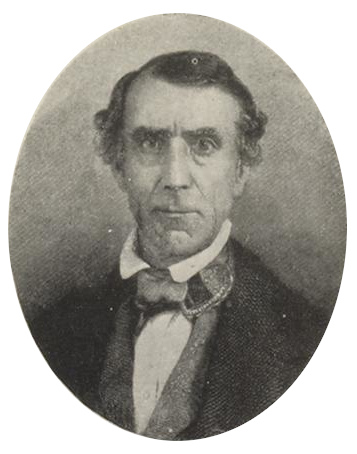
The Camp Street Theatre was constructed on what was then little more than a swamp. “I have seen two mules with a dray sink in a mudhole in the now well-paved Camp Street”, wrote Cowell in 1843, “and struggle for an hour till hauled out by ropes.” And yet it represented the germ of what would prove to be one of the finest theatres on the continent, the product of one of its most dogged and successful entrepreneurs, James H. Caldwell (1793-1863).
Caldwell was yet another English émigré, but unusually, one whose career had centred almost exclusively in the southern states. He had made his acting debut in Charleston in 1816, like Cowell as Belcour in The West Indian, but his main achievements lay in the field of theatre building and management. The theatre in Cincinnati that had been leased by Alexander Drake was his, as was the elder Drake’s theatre in Louisville, likewise theatres in Mobile, Nashville and St. Louis.
However, it was in New Orleans that James Caldwell would leave his most lasting legacy. Ignoring the obstacles of language barrier, French and Spanish being predominant in that city, Caldwell first established Camp Street, according to Cowell, as “one of prettiest of theatres, and better adapted to that peculiar climate”. In so doing, he also underscored the particular impetus that the entertainment industry, as it was then becoming, could have on an entire city. “In buying and improving property in the immediate neighbourhood […] it is now admitted”, Cowell claims, “that he is the actual founder of the Second Municipality […] its churches, hotels, squares, and well-paved expansive streets.”
In 1836, Caldwell would build three more theatres in New Orleans, The St. Philip Street Theatre, the St. Charles and the American Theatre, which was the first building in New Orleans to be lit by gas. Emphasising his business credentials, Caldwell became president of the New Orleans Gas Light and Banking Company. This last mentioned, a “temple of drama” in Cowell’s words, would fall victim to a fire on 13 March 1842 – the fate of so many theatres of this period on both sides of the Atlantic – to the cost of half a million dollars.
Cowell was engaged at the Camp Street Theatre until the following spring of 1830, whereupon he and Samuel planned their return to New York. Originally, they had booked passage once again aboard the steamboat Helen McGregor, but for some unstated reason, they arrived at the Levée five minutes after the vessel had departed. As it transpired, this was fortunate. The rickety and overcrowded craft struck disaster, her boiler bursting at Memphis, and the entire ship exploding, whereby “an extraordinary number of passengers were blown into eternity”. Cowell is phlegmatic. They immediately re-booked their passage on The Talma and within the space of twenty-eight days were once again back in New York to fulfil an engagement at the Bowery. At this point too, he and Samuel parted company, the young boy being enlisted in the military academy at Mount Airey, near the family home in Philadelphia. In 1840, he would depart entirely from his family to join the Adelphi Theatre company in Edinburgh under the direction of his uncle W.H.W. Murray (1790-1852).
Cowell’s stay in New York would be a short one. The manager, Charles Gilfert had died the previous summer and management of the Bowery had passed to Cowell’s friends and former associates Thomas Hamblin and James Hackett. However, it proved that “friendship has nothing to do with business” and after three nights, Cowell’s employment was terminated. Perhaps he had lost touch with his New York audience.
In response to the disappointment of his reception in New York, he decided to uproot entirely and, in his words “to make the Far West my home for the future”. For a month, he took over temporary management of the Richmond Theatre in Virginia where James Caldwell, and Charles Kean, son of Edmund, were then in residence. The Cowell family then travelled overland “by way of Charlottesville and the Sulphur Springs” all the way back to Ohio. Here they purchased a one hundred acre farm some eighteen miles northwest of Cincinnati from the estate of the future President of the United States, Benjamin Harrison, “a most amiable and kind-hearted neighbour” in Cowell’s recollection. It was his intention that the farm provide a new home and a living for the greater part of the year, while during the winter months, he might practise his profession on the stage.
In fact, when James Caldwell opened the St. Charles Theatre in New Orleans in 1836, he summoned Cowell from his self-imposed semi-retirement to join his company. However, in the midst of what appears to have been a highly successful return, illness struck. For the next four months, he was bed-ridden. Then, he offers another of those brief, ambiguous and somewhat opaque references to his personal life. There is the death of someone clearly very close to him, probably a family member. He recounts how the “beautiful Crescent City”, New Orleans, became the “depository of one unlettered tomb”. Could this have been his eldest son, Joseph Cowell Junior, whom we know to have died young? Or could it have been his young second wife, Frances Sheppard? We know that in time Cowell would marry for a third time, in 1848 to Harriet Burke. Once again, he is frustratingly reticent with his personal history.
In fact, Cowell remained with Caldwell’s company in New Orleans until the St. Charles Theatre was destroyed by fire in 1842. He then moved on to the Nashville Theatre, Tennessee, one of Caldwell’s other leases, for a season from April to July 1842. Here the star attractions of the company were Fanny Fitzwilliam (1801-54), another leading London actress on tour in America, and her then lover John Balwin Buckstone (1802-79), an English actor and playwright. However, the biggest success – certainly financially – came when Cowell struck up yet another Presidential connection, in the form of a visit to the theatre by the recently retired U.S. President Martin Van Buren.
Cowell’s seasons were growing shorter and further apart throughout this period. A planned return to New Orleans was thwarted by yet two more fires – this time at the American and Camp Street Theatres! “By design, no doubt”, Cowell ruefully reflects. Perhaps these pyrotechnic disasters may also, in some circumstances, have represented financial opportunities.
Be that as it may, his subsequent engagement would be at the Mobile Theatre in Alabama. This appears to have been something of a riotous venue where the lessee and manager, Jules Dumas, being also a successful restaurateur deemed it a good idea that the cast should in par be “paid in liquor”. A bar and dance hall was opened adjacent to the theatre where drinks were freely available at any time to the cast, as well as post-performance entertainment with live music. “I had a free admission”, acknowledges Cowell, “and went there every night.” One can only imagine what his family might have made of this, still firmly ensconced, no doubt, at the ‘retirement’ farm in Ohio. Or had that family, or those who remained, dispersed, and dissolved and with it the estate? We are not told.
Testament to the rising confidence of the indigenous American theatre was the increasing presence of native-born stars at Mobile. Among these was James Henry Hackett ((1800-71) who, having made his debut like so many others, at the Park Theatre in New York, established a strong reputation as a Shakespearean comedian. He also specialized in ‘Yankee’ characterizations whereby Cowell observes he “had an unapproachable resource in his ancestral dialect”. His praise is tempered though, as so often, by reference to the march of commercialism in the profession, as exemplified by Hackett who “may properly be called more a dramatic merchant than an actor”.
Further testament to this is the fact that the theatres were extending their repertoire and offering themselves as part of the academic lecture circuit, popularizing intellectual currents of the time. During Cowell’s period at Mobile, the scientific writer Dr Dionysus Lardner (1793-1859) presented his course of lectures on astronomy, while on the same evenings, the actor George Holland (1791-1870) provided dazzling interval entertainment with his exhibition of magic lanterns.
Another highly successful native-born actor in the company was Danforth Marble (1810-49) who, like Hackett, presented unashamedly Americanized portrayals in plays like The Backwoodsman and The Stagestruck Yankee. Cowell considered him an “irresistibly comic soul [who possessed] that extraordinary arbitrary power of making you laugh whether you want to or not”. And Cowell was astute in highlighting this gradual transformation in the American theatre, away from the classical English repertoire and dependence on British stars and towards its own original works and talent. When Marble died in 1849, such had been his popularity that he left behind a considerable legacy of $25,000.
Farewell to America (1843)
On the Friday evening of 7 April 1843, Joseph Cowell gave his farewell performance in America, and so far as we know, and in his own estimation at the time, his very last in any professional capacity. The notice read as follows:
“MOBILE THEATRE
Under the management of Mrs Richardson
FAREWELL BENEFIT
OF
MR JOE COWELL
Prior to his departure for some place, but where he don’t know, nor will anybody care.“
Self-deprecating and modest to the last, Cowell commenced the performance as one of his favourite characters, Meddle in London Assurance. Noah Ludlow performed “Seven Characters” and Mrs Richardson sang “a favourite song”. This was followed by a new, short farce featuring Joe Cowell and other company members and then finally a scene from The Widow’s Victim featuring Joe Cowell as Jeremiah Clip.
Joseph Cowell does not inform us as to the financial success or otherwise of this benefit, but we do learn that at the close of the production, he “wandered through Orange Grove, on my way to my solitary lodgings.” We may assume that by this time the rest (or what remained) of the Cowell family were back in Britain. Samuel was most probably already back in Edinburgh advancing his career through his mother’s family connections.
Joseph Cowell returned briefly to New Orleans where he saw the newly constructed St Charles Theatre (on the site of the old ‘Temple’) under the management of Noah Ludlow and W.H. Smith. Then he sailed on the brig Orchilla bound for Baltimore. Soon he would be back in his native England where, in 1848, he would marry for the third time, to Harriet Burke.
Return to England, Retirtement, Third Marriage & Death
According to the diaries of his daughter-in-law, Emilie Marguerite Ebsworth, wife of Samuel, Joseph Cowell retired to Putney, on the outskirts of southwest London. He seems to have suffered continuous financial problems. On Thursday 23 August 1860, she writes:
“Very dull letter from Sam’s father. He is in trouble about the rent of the house, which he and his friend, Mr Hudson were jointly liable for, and Hudson having gone away, a distress warrant was issued against poor Father.”6
The reference to a “distress warrant” reminds us of both the financial insecurity of Cowell’s profession and its continued taint of the status of “rogues and vagabonds” and this despite his purposeful and wide-ranging career. On Tuesday 9 October 1860, Emilie and Samuel sent him £10 from Canada and in December of that year a further $25 from New York. In that same letter of 23 August, she goes on to say:
“My dear boys are with him, and in his nervous state their happy light-heartedness annoys him.”7
Emilie and Samuel had eight children in all. It seems that Joseph Cowell and his third wife Harriet were for a while placed in charge of three of their sons to be cared for in England while they were on tour in North America. On 16 February 1861, she writes:
“Harris [a business associate] wrote a ‘business note’ to Father (Sam’s), telling him that he could take the boys away – which he did not wish to do. Harriet went to London, and saw the doctor, and took the boys to Putney. Next morning father went to see the Doctor, said he could not afford to keep them and that he knew you [Sam] never intended them to be taken away. The doctor consented to receive them again under his kind care.”8
We also learn from Emilie’s diaries that Joseph Cowell was in receipt of $30 per quarter from the American Theatrical Fund – a benevolent organisation of which he was a member, and which may have been his sole source of income, other than occasional charity from his son. “Even this pittance will be kept out of till next July [1861] due to some legal quibble”9, complains Emilie. Joe Cowell’s final mention in the diaries comes in an entry for 10 April 1861, as follows:
“Letter […] from Father […] telling us that all is right in London and Putney, and the three babies, Florence, Murray and Joe are recovering from the measles! My brother Joe had been in London, and called on the boys at school, also at Putney. Father had decided to let Ned and Alfred spend their ten days’ vacation at school, as the excitement of having the three boys would be too much for him.”10
It seems that Joseph Cowell spent a happy, though somewhat impecunious, retirement in the company of his third wife and his grandchildren. He died in Putney in November 1863 and is buried in Brompton Cemetery.
FOOTNOTES
- See The Oxford Companion to American Theatre
- See The Oxford Companion to American Theatre
- See The Oxford Companion to American Theatre
- See The Oxford Companion to American Theatre
- See The Oxford Companion to American Theatre
- Cowell, Mrs Sam The Cowells in America: The Diary of Mrs Sam Cowell ed. M.Willson Disher. London. OUP. 1934
- ibid
- ibid
- ibid
- ibid
