The Reclaiming of an Authentic African-American Contribution: Part Three: Repression & Diaspora
The African Grove Theatre
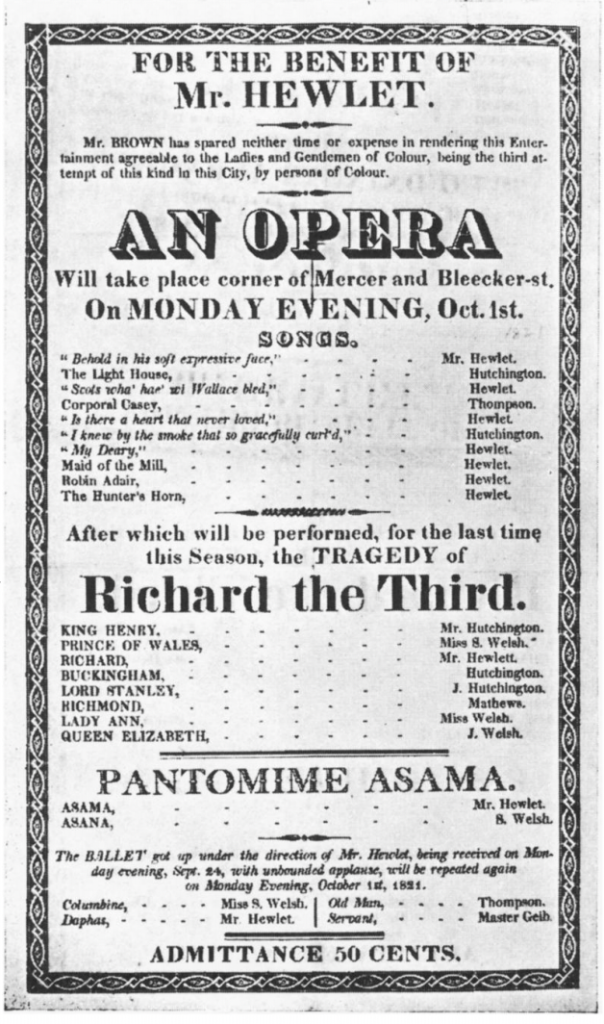
Early nineteenth century New York City was home to a large community of black musicians and performers. However, until the Emancipation Act of 1827 in that state, such artists were banned from white theatres, while audiences were either racially segregated or black spectators entirely barred. The only venues that remained open to black performers were the less formal bars and clubs along the bustling thoroughfares such as Church Street or ‘Black Broadway’ as it was dubbed, running parallel to its white counterpart. Here the taverns and dance halls, the brothels and gambling houses would have provided ready engagements for musicians and performers of all stripes, just as they had for ‘Master Juba’. It is in such vibrant urban settings that later generations of artists like Scott Joplin, Louis Armstrong and Fats Waller would duly follow.
The one courageous attempt at establishing a more formal venue for the performing arts among the black community, was the African Grove theatre, founded in 1821 by the freed slave, West Indian entrepreneur, William Henry Brown.58 This much-loved institution offered a range of theatrical and musical programming from Shakespeare to popular dance music. However, the Grove suffered frequent harassment from police and racist mobs, not least through envy of its success; something which itself testifies to the appetite for the creative arts among the early nineteenth century black community. Finally, in January 1822, its production of Richard III, starring a black lead actor in the person of James Hewlett, was overrun by a rioting white mob. This ‘protest’ had been deliberately orchestrated by the managers of its nearby rival, a whites-only theatre called the Park, who were themselves staging a production of the same play. The New York police duly arrested the black cast and shut down the African Grove. This valiant enterprise had lasted barely a year.
In the ensuing decades, the harassment of the black population in the northern states would only worsen with the presence of professional slavecatchers who would routinely return escapees (and indeed any unfortunate and vulnerable black citizen they chose to apprehend) to their so-called southern ‘owners’, often with little resistance from the local state administration, constrained as they were by prejudicial federal law. The slavecatchers’ actions were further emboldened in 1850 by the notorious Fugitive Slave Act that sought to prevent the individual ‘free’ states from harbouring such fugitives; a law which in many ways (in a country as deeply divided, and along similar fault-lines as it is today) was to trigger the American Civil War a decade later.
In such a climate, even legally freed blacks were at risk of kidnap and bondage into slavery. Their documentation could be negligible or non-existent, and their recourse to the law severely hampered. Petersen notes that from the 1840s onwards, the black community of New York was in a steady decline, representing a mere 2% of the population from its former 10% at the turn of the century.59 Its one-time communal hub around the Five Points had now become largely inhabited by Irish newcomers, its families and businesses dispersed to the more peripheral wards. The picture that emerges is of a steady and deliberately imposed fragmentation and of a diaspora of black refugees, even further afield, out of the northern states and into Canada and across the Atlantic. Forming a substantial part of this diaspora would be a swathe of black American musicians who would plant the first seeds of an authentic black minstrelsy in Great Britain.
James Hewlett & Ira Aldridge
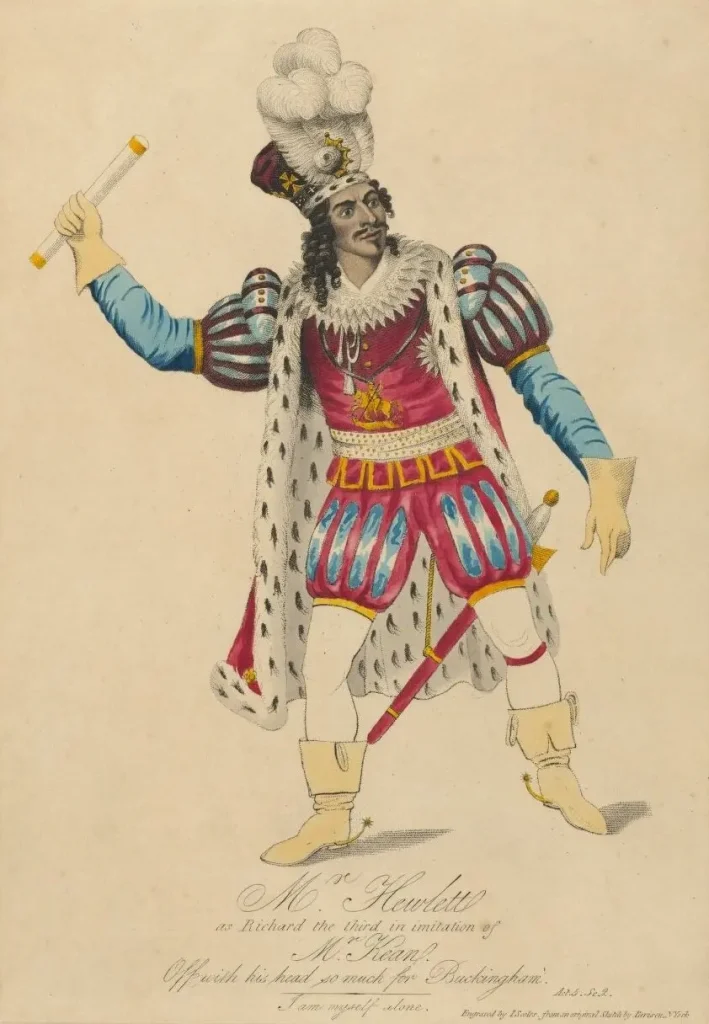
Among them was the actor James Hewlett who, having been arrested and ejected from the Grove theatre in 1822, signed up as a steward aboard a British ship in New York harbour as did countless other fugitive and freed black people. Ira Aldridge, the great Shakespearean actor, and singer, who had also made his stage debut at the African Grove, would similarly make his way across the Atlantic in 1824 to find international fame and fortune in Great Britain and continental Europe. Whilst touring America in 1822, the British actor and mimic, Charles Mathews witnessed Aldridge at the African Grove and based his racist parody, which he referred to as ‘black fun’, on his performance. This act Mathews subsequently performed at the Adelphi theatre in London as part of his show A Trip to America, thus preparing the ground in some ways for T. ‘Daddy’ Rice’s ‘Jim Crow’ that was to follow. 60
Aldridge also introduced Mathews to the song ‘Opossum Up a Gumtree’.61 Cecilia Conway has revealed that this song was a variant of a tune well-known in Philadelphia and the Five Points dance halls of New York in the time of ‘Master Juba’ and of Charles Dickens’ visit to America.62 Furthermore, Hans Nathan confirms that the song was previously long-known to African Americans in South Carolina.63 Interestingly, it demonstrates the characteristic ‘call and response’ form, the repeated refrain of a traditional African American work song.
Possum up a Gum Tree
Up he go up he go
Racoon in the hollow
Down below down below
Him pull him by hims long tail
Pully hawl, pully hawl
Then how him whoop and hallow
Scream and bawl, scream and bawl.
Ira Aldridge would take this song with him to Britain. Having established his reputation on the London stage in Othello, the first black actor to do so, he later took on the starring role of Mungo, an African slave, in an updated version of Dibdin and Bickerstaffe’s eighteenth century plantation-based operetta The Padlock. This work had first been produced in Philadelphia in 1769, and while it may have expressed a broadly anti-slavery sentiment, at the same time it somewhat paradoxically represented its central black character, Mungo, in comically stereotyped mode. Aldridge transformed the role, openly displaying his anti-slavery sentiments in direct speeches to the audience at the end of the play. He also added a minstrel song to the essentially Italianate musical score. Accompanying himself on guitar, he included ‘Ol’ Possum Up A Gumtree’. Consequently, this song has perhaps some claim to be the first genuine black minstrel song to be performed on the London stage; several years before the pro-slavery blackface minstrel Thomas ‘Daddy’ Rice would appear. As Michael Pickering points out:
[…] along with his brilliance as an actor of both Shakespearian drama and melodrama, Aldridge excelled in performing the popular song material he commonly sang on stage to his own guitar accompaniment. 64
As part of this parallel career as a musical performer, Aldridge would include other minstrel numbers to his act, such as ‘Lucy Long’, ‘Coal Black Rose’ and ‘Jim Along Josey’. Abraham and Woolf observe:
Aldridge amused audiences with minstrel acts into the 1850s and beyond, winning fans as he appropriated popular racist culture to his own ends. But it’s hard to do more than speculate as to why he performed minstrel acts rather than ignoring them altogether. 65
Perhaps, originating from New York as he did, Aldridge, like ‘Master Juba’ who was to follow him, sought to reclaim what he felt to be the authentic black American input into these and other pieces and simultaneously to encourage those other black performers who lacked any access to the mainstream stage. As Burrows and Wallace have pointed out: “Minstrelsy had many seedbeds, but one of the most important lay in black Manhattan”.66
Black Sailors
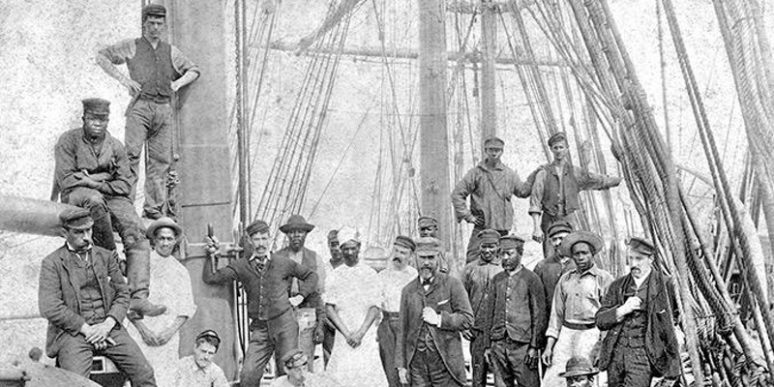
Hewlett and Aldridge were just two amongst a whole wave of exiles who made their way across the Atlantic during this period. Many would sign on for work aboard ship as stewards or seamen, an occupation which represented a relatively safe and equitable form of employment for black people, either permanently or as a temporary means of passage and migration. Indeed, such were the numbers that Paul Cuffe, known as the ‘African Captain’, was able to employ blacks-only crews across the Atlantic.67 Brian Roberts observes:
The proportion of African American workers in the maritime trades was higher than in any free-labor-based industry in the United States. According to one count, on the eve of the Civil War there were some six thousand black men serving on American vessels, another three thousand on whaling ships.68
Burrows and Wallace, in their definitive history of New York entitled Gotham, underline the deeply segregated nature of that city’s society and the extremely limited employment opportunities for its black citizens. They further point out:
Many black men […] took to the sea, as sailors, stewards, or cooks, so many that in the late 1820s the African Free School added navigation to its curriculum. […] In 1835 nearly 25 percent of the black men sailing out of New York City were members of predominantly black crews. 69
In support of this we might also observe that ‘Master Juba’ following on from his success in New York at Five Points and Barnum’s Vauxhall Gardens took himself on tour along the northern Atlantic seaboard. While his defeated white rivals typically headed south to Philadelphia, Baltimore, Richmond or New Orleans in the more conservative slave states, ‘Master Juba’ played the maritime ports, which according to Cook, “may suggest that sailors, dock workers and other poor laborers constituted Lane’s core audience early on.”70 These were more cosmopolitan, multi-cultural environs with direct trade routes to Europe and many such workers would have been of African American descent.
A maritime exodus was underway. And what these seamen took with them was the long tradition of sea shanties, many of which were characterized by the typical African American ‘call and response’ structure “that scholars have identified as coming from Africa or slavery.”71 An example is ‘Blow, Boys, Blow’, a song from the slave ship blockade fleets of the early eighteenth century and which reflects the mariners’ disgust at the continuing trade.
Oh, was you ever on the Congo River?
Blow boys, blow
Where fever makes the white man shiver
Blow me bully boys, blow
A Yankee ship come down the river
Her mast and yards they shone like silver
What do you think she’s got for cargo?
Why, black sheep that have run the embargo
What do you think they’ve got for dinner?
Oh, monkey hearts and donkey’s liver
Yonder comes the Arrow packet
She fires the gun, can’t you hear the racket?
Oh blow me boys and blow forever
Oh blow me down that Congo river72
Liverpool
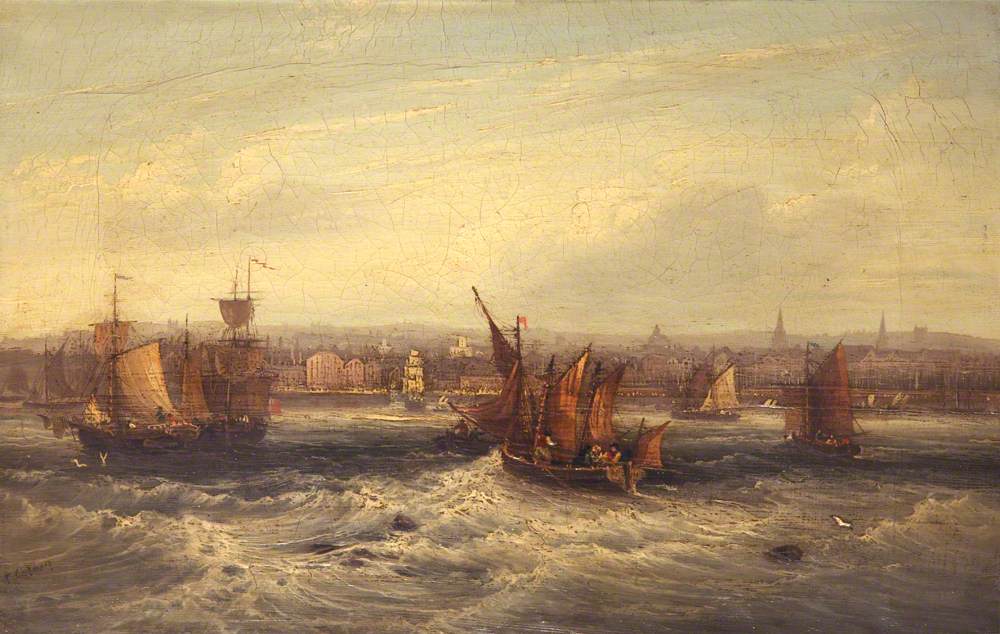
It was to Liverpool, the city that represented the principal hub of Anglo-American trade and travel in the late eighteenth and early nineteenth centuries, that a great many of these sailors and exiles would embark. Appointed American Consul to Liverpool between July 1853 and October 1857, the author Nathaniel Hawthorne recalled an “endless panorama of supplicants coming to his office”73 Though he did not specify race – which typically of the time, official documents failed to record – he did note in his English Notebooks the relentless flow of migrants from the United States, even while, simultaneously, many white Europeans were migrating in the other direction:
The stairway and passageway were often thronged, of a morning, with a set of beggarly and piratical-looking scoundrels (I do no wrong to our own countrymen in styling them so, for not one in twenty was a genuine American), [it should be noted here that black people, at this time, were commonly regarded and referred to as African rather than American] purporting to belong to our mercantile marine, and chiefly composed of Liverpool Blackballers [a shipping company] and the scum of every maritime nation on earth.74
Those among these destitute refugees who were able to would have utilized what musical skills they had in the bars and saloons, and along the Liverpool waterfront. Hawthorne also noted in The English Notebooks of 1854:
The vagabond musicians about town are very numerous and miscellaneous. On board the steam-ferry boats […] they infest them from May to November, for very little gain, apparently.75
The American author, Herman Melville, a friend of Hawthorne’s, having worked his passage across the Atlantic in 1839, described vividly in his early novel Redburn, his recollections of the multifarious tavern musicians at work in Liverpool at the time.
In the evening, especially when the sailors are gathered in great numbers, these streets present a most singular spectacle, the entire population of the vicinity being seemingly turned into them. Hand-organs, fiddles and cymbals, plied by strolling musicians, mix with the songs of the seamen, the babble of women and children, and the groaning and whining of beggars […] the noise of revelry and dancing […] greetings are exchanged between old sailors who chance to stumble upon a shipmate last seen in Calcutta or Savannah. […] one of the most curious features is the number of sailor ballad-singers, who, after singing their verses, hand you a printed copy, and beg you to buy.76
Note that Melville makes a specific reference to Savannah in the southern state of Georgia, one of the cradles of black plantation music. He then proceeds to underline the relative acceptance of black people and their freedom to openly mix with the white population in England, as compared to the United States.
In Liverpool indeed the negro steps with a prouder pace and lifts his head like a man; for here, no such exaggerated feeling exists in respect to him, as in America. Three or four times I encountered our black steward, dressed very handsomely, and walking arm in arm with a good-looking English woman. In New York, such a couple would have been mobbed in three minutes; and the steward would have been lucky to escape with whole limbs. Owing to the friendly reception extended to them, and the unwonted immunities they enjoy in Liverpool, the black cooks and stewards of American ships are very much attached to the place and like to make voyages to it.77
Middle-Class African Americans in Liverpool
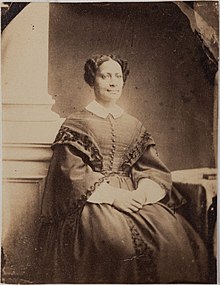
It would be wrong to create the impression that all African American visitors to Liverpool at this time were exclusively working sailors, musicians and destitute fugitives. The relative freedoms and relaxed attitudes that Melville refers to were also echoed by many eminent, middle-class, black American abolitionist speakers who were drawn to the city; for example: William Lloyd Garrison (in 1833 & 1840); Moses Roper (in the 1840s); Alexander Crummell (between 1848-9); William & Ellen Craft (in 1850); James Watkins (in 1852); Samuel Ringgold Ward (in 1853); William Wells Brown (between 1849-55); Frederick Douglass (between 1845-6); and Sarah Parker Remond (between 1858-9).
Among their number, there were those like Frederick Douglass and William Wells Brown, who rather frowned upon the kind of tavern music and plantation songs that the itinerant minstrels performed. As previously noted, they considered them too rooted in slavery and lacking in sophistication. Frederick Douglass’ own expressed preference was for a more classical strain of music, particularly as represented by the African American opera singer Elizabeth Greenfield, dubbed ‘The Black Swan’.78 William Wells Brown compiled his own anthology entitled The Anti-Slavery Harp: A Collection of Songs for Anti-Slavery Meetings. This included ‘The Lament of the Fugitive Slave’, as well as various ballads, hymns, and classical melodies. These preferences reflected their own political and social drive towards what they considered respectability and education within the black community.79 Nevertheless, a vibrant, vernacular and secular strand of black music had arrived on English shores, and it would thrive.
The Black Communities of Georgian Britain
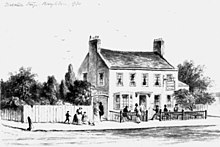
Many of these abolitionist speakers went on to present anti-slavery orations throughout Great Britain. However, they were not the first black Americans to have arrived and, in some cases, settled, in the United Kingdom. On the contrary, they would have found an already well-established black presence in the major provincial and port cities such as London, Liverpool and Bristol.
It has been well documented by Gretchen Gerzina and David Olusoga, among others, that half a century before the arrival of James Hewlett and Ira Aldridge in the 1820s, a substantial wave of black migrants had arrived on British shores from the Americas as a consequence of the American War of Independence. It is estimated that some 14,000 former slaves, a number equal to what was then already the entire recorded black population of Britain, were dispersed either to the Caribbean colonies or to the United Kingdom. Hundreds more made the journey to Nova Scotia. Most had fought as ‘loyalists’ on the side of Great Britain during the conflict and thus sought sanctuary at its conclusion. Gretchen Gerzina observes:
Most arrived penniless, aware that the English government was reluctant to make good on earlier promises – and their colour, homelessness and destitution made them highly visible on English streets.80
Some of those who were able to, took recourse to playing music, often on the streets or in public-houses. Shadrack Ferman, for example, played fiddle. This is (unusually) documented in a petition to the government commission on financial claims:
Shadrack Furman – a free Black […] came to England in March last – he has a wife with him – Lost property to the amount of more than 146£ – he has been able to support himself by playing the Fiddle.81
From this Georgian diaspora, whole new black communities had developed, often with a local public house as a communal hub. David Olusoga points out:
Black servants in the city [London] appear to have organised their own gatherings in taverns. The Yorkshire Stingo, a pub in Marylebone, was said to serve a largely black clientele and in 1764 the London Chronicle reported that ‘Among the sundry fashionable routs or clubs, that are held in town, that of the Blacks, or Negro servants is not the least…..on Wednesday night last, no less than fifty-seven of them, men and women, supped, drank, and entertained themselves with dancing and music, consisting of violins, French horns and other instruments, at a public-house in Fleet Street, till four in the morning. No Whites were allowed to be present, for all the performers were Blacks.82
Indeed, the presence of black musicians was well enough established, even by the 1780s for Charles Dibdin, author of The Padlock, to be able to present their impersonation in his Fiddle Entertainments between 1707 and 1805.83 One of the songs featured was entitled ‘The Negro and the Banjo’, emphasising just how rapid and widespread was the migration of that instrument and its deep association with the black community.
Away from the metropolitan centres, recent research has unearthed evidence of a substantial black community involved in the knitting trade of Yorkshire. The Sill family ran the hosier industry in the town of Dentdale, while also benefitting from the proceeds of a slave plantation in Jamaica called Providence. The family also appear to have had slaves of African origin in Dentdale. An advertisement for a runaway slave named Thomas Anson appeared in Williamson’s Liverpool Advertiser in 1758. The independent researcher Audrey Dewjee has discovered that in 1760 Thomas Ansom subsequently enrolled in the 4th Dragoons as a trumpeter, a position he held until his discharge with injury in 1768.84 (annkingstone.com/and-did-black-hands-in-ancient-times-knit-upon-yorkshires-mountains-green/)
Street Musicians & Visual Art
In the course of the nineteenth century, black musicians became so common in the bars and streets that the authorities and commentators found them unremarkable. In 1868, a contributor to the St James’ magazine was able to observe that by then, black entertainers were ‘continually wandering through the country.’85 James Greenwood in The Wilds of London (1874) remarks how an anti-slavery song, ‘Mary Blane’, and an old plantation song called ‘Poor Jeff’, had become popular tavern songs regularly performed in sing-arounds.86 While in 1860, a correspondent to the London Mail and Telegraph observed:
[….] within the last 20 years it [minstrelsy] has grown into what may be called the music of the country […] their popularity is universal, and they lay hold of all classes and all diversities of taste, and just as active in our streets, in their most contemporary delivery, as in our theatres and concert rooms.87
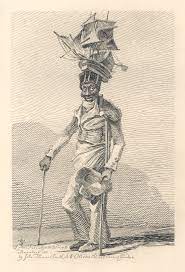
Those ‘in our streets’ constituted what Michael Pickering has referred to as ‘plebeian minstrelsy’, many of whom would have been poorer, marginalised white blackface performers.88 However, black musicians had been present on British streets since the eighteenth century, some of whom clearly stood out, in particular those of a striking appearance. Joseph Johnson, for example, sang on the streets of London and throughout the provinces, adorned with a replica of the ship Nelson upon his cap, sometimes placing his head below the level of a drawing room window he proceeded to bob up and down and thus mimic the motion of the seas to the amusement of those within. He naturally drew the attention of artists such as John Thomas Smith who engraved his portrait for Vagabondia in 1815. Indeed, black musicians are commonly seen in the art works of the time. An engraving by C.L. Smith of July 1794 features a black horn player. A black fiddle player dominates the proceedings in Gillray’s engraving The Union Club. And a tin whistle player appears among the massed black faces in George Cruikshank’s 1821 engraving Tom and Jerry Masquerading Among the Lodgers in the Black Slums.89 Another such was the one-legged fiddle-player Billy Waters, one of those dubbed the St Giles’ ‘blackbirds’, who regularly busked outside the Adelphi theatre on the Strand sometimes appearing with his companion ‘African Sal’. His image was captured by the engraver Thomas Lord Busby. 90
It is clear that well before the arrival of blackface minstrelsy in Britain, in the person of T. ‘Daddy’ Rice in 1836, and increasingly over the subsequent decades in parallel to the blackface phenomenon, there was a significant and widespread community of black musicians performing in Great Britain. As Pickering has noted:
So, in the two decades prior to Rice’s huge success, and even more before that, blacks provided street and tavern entertainment in London and in the slave ports. There was a clear link back from minstrelsy to black people themselves.91
In Part Four I shall conclude my study with an exploration of the establishment of an authentic black minstrelsy in the seaside ports and resorts of Great Britain and its eventual transference to and transformation of mainstream musical theatre in the West End and Broadway.
FOOTNOTES:
- 58 Petersen: 176
- 59 ibid:28-9
- 60 Abraham, Keisha N. & Woolf, John Black Victorians: Hidden in History (Duckworth 2022): 164
- 61 Pickering: 7
- 62 Conway, Cecilia African Banjo Echoes in Appalachia (University of Tennessee Press 1995)
- 63 Hans Nathan, Dan Emmett and Negro Minstrelsy (Univ. of Oklahoma Press, 1962)
- 64 Pickering: 6
- 65 Abraham, Keisha N. & Woolf, John Black Victorians: Hidden in History (Duckworth 2022): 174-5
- 66 Burrows, Edwin G. & Wallace, Mike Gotham: A History of New York City to 1898 (OUP 1999): 487
- 67 Speed, David American Travellers in Liverpool (Liverpool University Press 2018): 185-219
- 68 Roberts :107
- 69 Burrows, Edwin G. & Wallace, Mike Gotham: A History of New York City to 1898 (OUP 1999): 547-8
- 70 Cook ‘Discourses in Dance’ Vol. 3, issue 2: 8
- 71 Roberts:107
- 72 Ibid:109
- 73 Seed:114
- 74 Hawthorne, Nathaniel Our Old Home: A Series of English Sketches (pub.1863) quoted in Speed: 115
- 75 Seed: 128-9
- 76 Melville, Herman Redburn (Penguin Classics, London 1987): 263-5
- 77 Ibid: 277
- 78 Roberts: 103
- 79 See W.E.B. DuBois The Souls of Black Folk (OUP 2008)
- 80 Gerzina, Gretchen Black England: A Forgotten Georgian History (John Murray, London 1995): 156
- 81 Ibid: 157
- 82 Olusoga, David Black & British (Pan Macmillan 2021): 100
- 83 Pickering (2016): 7
- 84 Online article: annkingstone.com/and-did-black-hands-in-ancient-times-knit-upon-yorkshires-mountains-green/
- 85 The St James’ Magazine n.s.1 Apr-Sep. 1868
- 86 Greenwood, James The Wilds of London 1874. Republished by Taylor & Francis 1985
- 87 London Mail and Telegraph 21 Jul. 1860. Quoted in Pickering: 56
- 88 Pickering, Michael ‘Blackfacing Britain’in Racism and Modernity ed. Iris Rigger and Sabine Ritter (Vienna and Berline: Lit Verlag 2011).
- 89 See Gerzina: plate illustrations.
- 90 Pickering (2016): 78
- 91 Pickering (2016): 79
