The Reclaiming of an Authentic African-American Contribution: Part Four: From Seaside to West End
Stage & Seaside Entertainers
When the white American blackface minstrels first arrived in Britain, they were immediately able to take up formal residency in auspicious, professional theatres. Rice performed in the West End at the Adelphi theatre in 1836, while in 1843, Dan Emmet was able to take his Virginia Minstrels directly into the Theatre Royal,Liverpool, as did Sam Hague with his Great American Slave Troupe in 1866. The vast majority of black musicians would enjoy no such opportunity. Their playing was largely restricted to the taverns and dance halls of the port city waterfronts and urban centres. However, it was during these same decades that the burgeoning coastal resorts such as Blackpool, Hastings, Bournemouth, Brighton and Margate were beginning to establish their seaside promenades, piers, and beaches as performance spaces. These represented a natural territory for the black buskers “wandering the country” (as observed in The St James’ Magazine in 1868).92 Their means of transport was also becoming much more easily facilitated by the vastly expanding railway system that had been underway since the 1830’s. Thus, the circumstances were entirely ripe for black minstrelsy to establish itself amid the flourishing holiday culture.
What would have undoubtedly added a certain piquancy to their presence was the overall atmosphere of perceived exoticism and less inhibited tolerance that pervaded these environs. The coastal resorts were generally characterised by a faux imperial style of mock-oriental architecture complete with elaborately ornate piers and concert halls. They characteristically displayed such features as Moroccan domes and minarets, decorous ironwork depicting entwined dragons and serpents, and arabesque ceramics and mosaics. They were places deliberately designed to cater for the indulgences of pleasure-seeking, carefree consumption and uninhibited bathing, their verdant winter gardens bedecked with palm-trees and tropical flora and flag-adorned bandstands. It was an atmosphere replete with ironies that were elegantly captured in a later period by Joan Littlewood’s Brighton pier setting of the 1963 Theatre Workshop production Oh, What A Lovely War! And it represented an exoticism that would have seemed quite familiar in its extravagance to contemporary American visitors who were enjoying their own home-grown excesses in the form of fantastical ‘Indian songs’ for middle-class parlours, P.T. Barnum’s circuses and the touring spectacle of Buffalo Bill’s Wild West extravaganzas. Itinerant African American minstrels would fit perfectly into such a setting.
However, the language of the time also reflects worsening racial attitudes as the century progressed. In contemporary parlance the performance space of these travelling players was commonly referred to as the ‘n***** ring’; a term that persisted even when these spaces began to be usurped by white performers in blackface make-up. These busking pitches constituted little more than a simple plot of sand on the beach, or a podium of plain boarding encircled by a ring of rope or a makeshift fence. They might enclose a few rows of deckchairs or benches arranged to entice a passing audience to sit and watch for a token price.93 There is scant evidence of who exactly these early ‘plebeian’ performers might have been, but Sophie Nield has rightly observed:
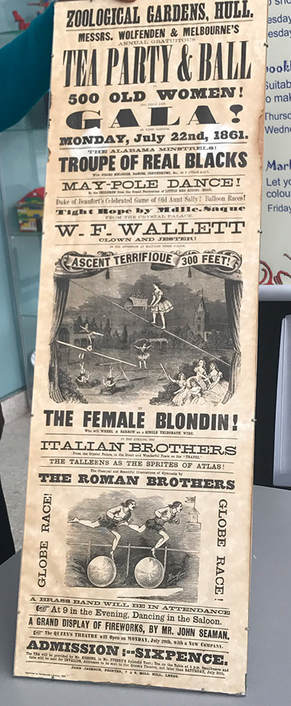
[…] minstrelsy was not only performed by white men in black masks. [..] In 1861 an advertisement for Messrs Woolfenden and Melbourne’s ‘Annual Gratuitous Tea Party and Ball to 500 Old Women and their last Gala’ in the Zoological Gardens, Hull, listed the Alabama Minstrels as a ‘Troupe of Real Blacks with negro melodies, dances and conundrums’. 94
This troupe made a sufficiently strong impression to be invited to perform once again in Hull the following year, this time at the Queen’s theatre on Paragon Street.95 But for a chance finding of these advertising posters, such information would have remained entirely lost, thus underlining once more the difficulty of obtaining primary sources in these matters.
A Growing Black Presence in Victorian Britain

It has been a common consensus that the size of the black community in Britain declined during the first half of the nineteenth century from its height in the Georgian era.96 As evidence it is cited that in his survey of the London poor, Henry Mayhew only encountered one genuine ‘negro’ among the 50 or so blackface minstrels he encountered in the 1850’s.97 Reasons given are, for example, the end of the British slave trade in 1808 and the inter-marriage of black migrants with the white population.
However, I would respectfully challenge this view and suggest that these appraisals may represent an underestimation of the numbers involved. Race or colour as such was never specified in census returns of the period. And with regard to intermarriage, it is not uncommon, even after a second generation, for those of mixed ethnicity to identify (and be identified) with the black community. Furthermore, there is strong circumstantial evidence of a continual and steady migration into Britain from America. In support of this, I would cite the anecdotal evidence of Hawthorne and Melville and others regarding the arrivals of migrants between the 1830’s and the 1850’s. Furthermore, I would cite Petersen’s research into the declining black population and the diaspora from New York and other north-eastern cities, along with the increasing repression and hostility in America towards that community. (See Part Three of this article).
As additional evidence, I would propose the relatively large number of African Americans taking to the sea for employment and refuge. And one might equally speculate that those African Americans who had fled America as fugitive slaves would have had an added incentive to avoid official-looking, information-gathering figures in the main urban centres; figures like Henry Mayhew in London and Charles McKay in Liverpool. In such circumstances, it would be only logical for them to operate in the more remote and provincial parts of the country away from officialdom, and beyond the reach of slave-catchers and kidnappers; especially in the seaside resorts that offered the opportunity of casual employment. After all, even a relatively protected and celebrated figure such as Frederick Douglass had recourse to purchase his freedom while still in the United Kingdom in order to guarantee his future liberty.
The presence of black performers is further highlighted by those increasing numbers who, as the century progressed, were accepted onto the mainstream, professional stage; not only William Henry ’Master Juba’ Lane – but also, ‘Japanese’ Tommy Dilward who appeared with Sam Hague’s Georgia Slave Troupe alongside Abe Cox, Neil Solomon and Aaron Banks.98 Indeed, in 1866 Hague’s original troupe featured no less than 26 black performers who had formerly been slaves. However, when they failed in his eyes to give an adequate representation, most of them were summarily dismissed and replaced by a white blackface cast. Abandoned to destitution, those who did not return to America further swelled the ranks of Liverpool’s itinerant musicians.99
At the same time, the all-black Wilmington Singers and The Fisk Jubilee Singers would also establish themselves on the mainstream circuit, as would Billy Kersands, James Bland, The Bohee Brothers, Richard Little and John Alexander Little.100 Among these black American performers were many who chose to remain and settle in Britain, among them Isaac Cisco of the Wilmington Singers; while Esther Ann ‘Hettie’ Johnson, Birmingham-born daughter of the American singer John Alexander Johnson, along with many others, took advantage of the employment opportunities offered by the many popular stage adaptations of Uncle Tom’s Cabin.101
Most, if not all, of these performers were constrained to follow the parameters of a white-dominated idiom, even to the point of having to apply burnt cork make-up to their own skins and to adopt many of the racist tropes of the performance style. Yet at the same time they were able to establish a first foothold on the mainstream stage, a first step that would gradually lead to others – a process, one might say, still in progress. Simultaneously, these artists could stake a valid claim to the original contribution that black culture had made to this very idiom of minstrelsy and the modern musical show song.
Zadie Smith writes in her foreword to Gretchen Gerzina’s Black England, “I wanted to know for reasons of my own self-esteem – that the history of the African diaspora was not solely one of invisible, silent suffering. I wanted to hear about agency, heroism, revolt.”102 Here, surely, is one example. Against enormous difficulties, and repressive hostility, elements of an authentic African American musicianship established itself in the bars, saloons, taverns, dance halls and coastal promenades on either side of the Atlantic; and from those same beginnings that had initially spawned black minstrelsy, there would subsequently emerge a whole host of genres from the ‘ragged’ rhythms of ragtime and jazz through to swing, pop culture and the modern musical.
Summary
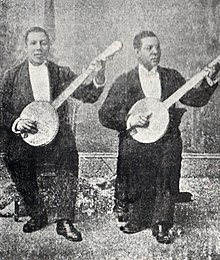
So, to summarise, there is a good deal of evidence to suggest that there existed an authentic black minstrelsy and that it was introduced and established in Britain prior to the appearance of its blackface parody.
In the first place, the essential and characteristic instruments of minstrelsy, the banjo and percussive tambourine and bones, owe their origins to African American and plantation heritage. Secondly, the African American playing style of these instruments migrated throughout the United States in the eighteenth and nineteenth centuries and informed the techniques of all minstrelsy, often through direct contact between African American and white performers. While it is virtually impossible to definitively unravel the various elements in the fusion of styles that took place between Anglo-Celtic folk and Black folk music, it is clear there was a strong African American input and many tunes have been traced to their original plantation sources.
In addition, there came to be established a significant community of black musicians in the ‘free’ north-eastern states where white blackface minstrelsy first emerged. These musicians had their own playing spaces outside the mainstream in the markets, saloons and dance halls, where their authentic (i.e., non-parodic) music thrived. Subsequently, many such performers, including James Hewlett, Ira Aldridge and Master ‘Juba’ Lane made their way across the Atlantic where they would have found an already well-established black community that had its origins in the mid to late eighteenth century.
At the same time, the increased repression of ‘free’ and fugitive former slaves in America from the 1820’s onwards, intensified by the 1850 Fugitive Law, instigated an increase in the flight and diaspora of black people both to Canada and to Great Britain. Given the evidence of a depleted black population in New York and other northern cities and of contemporary testimony (such as by Hawthorne and Melville) it seems probable that the migration of African Americans to Britain in the nineteenth century may well have been underestimated.
Furthermore, while contemporary observers such as Henry Mayhew counted relatively few black beggars or buskers on the streets of London for example, those African American fugitives who found themselves in desperate straits would have had every incentive to avoid detection by the authorities, and therefore to take advantage of the opportunities offered by the burgeoning coastal resorts. Finally, there is clear evidence of the continued presence of black minstrel entertainers well into the 1880s and beyond in the form of such players as the Alabama Minstrels, James Bland, the Bohee Brothers, Billy Kersands and many others.
Conclusion

However off-putting it might initially sound, imagine for a moment a contemporary re-staging of The Black & White Minstrel Show, in the light of recent scholarship. Imagine a show that would reflect the very first minstrelsy that those early black musicians brought to the dance halls and taverns of Liverpool and London, and thereafter to the promenades and concert halls of provincial towns and seaside resorts of Britain.
In the first place, the cast would be genuinely diverse, without the deplorable application of ‘burnt cork’ make-up and it would consist of male and female performers in equal numbers and of equal diversity of age and background. The costumes could reflect contemporary dress, as did those of the original street performers themselves. The programme might begin with renditions of those tantalizing ‘scraps’ from the Hans Sloane Collection as performed by Rhiannon Giddens – the authentic sound of the prototype banjo as played in the Caribbean and southern states. This might be followed by a series of genuine plantation songs, such as the misappropriated tune of ‘Jump Jim Crow’ presented in its original form of a children’s singing game from the Georgia Sea Islands. To this we might add ‘Get Off the Track!’ which is the anti-slavery, emancipation song version of ‘Old Dan Tucker’, the tune itself having its origins in late eighteenth century Elbert County, Georgia. We might invite a performer to represent Ira Aldridge offering his anti-slavery rendition of ‘Opossum Up A Gumtree’ or of Aaron Banks delivering his signature number, the ‘Emancipation Song’.
Then there are the African American work songs such as ‘John Henry’ (that originates from West Virginia), and ‘The Road Gang Song’ and ‘Gonna Leave Big Rock Behind’, all of which are featured in John Work’s collection compiled in 1940.103 Time then for a selection of spirituals from the repertoire of the Fisk Jubilee Singers – ‘Shout for Joy’, ‘Swing Low Sweet Chariot’, ‘Deep River’ and ‘Nobody Knows the Trouble I See’. A whole host of tunes owe their origins to the mixing of English, Celtic and Black styles in Kentucky, Virginia, Maryland and the western territories; tunes such as ‘Turkey in the Straw’, ‘The Yew-Pine Mountain’ and ‘The Kicking Mule’. We might then take to the sea with a selection of sea shanties that feature the traditional African American call and response lyric form – ‘Blow, Boy, Blow’, ‘Round the Corner, Sally’, ‘Old Stormy’ and ‘Time for Us to Go’.
The grand finale might consist of a rousing medley of numbers from In Dahomey.104 First produced on Broadway in 1903, this was the first all-black musical comedy performed in a major American theatre, and a precursor of the modern musical. The score utilizes a blend of ragtime, minstrel and operetta styles and was composed by Will Marion Cook, a descendant of slaves who had studied at the National Conservatory of Music with Anton Dvorak. It is a recognisably modern piece, far removed from the Gilbert and Sullivan operettas and Gaiety ‘Girl’ musicals so popular at the time. It transferred to London’s Shaftesbury theatre in April 1903 and was even performed at Buckingham Palace on the occasion of the Prince of Wales’ birthday. Numbers such as ‘The Czar’ or ‘Society’ or the ‘In Dahomey Overture’ would capture the spirit and flavour of the work.
As a final coda to the event, we might hear once more those fragments of the original Caribbean scores from the Hans Sloane Collection – a reminder of the source of so much of this music. It is not possible to definitively separate out all the various strands of the cross-cultural process that represents nineteenth century minstrelsy, but is possible to recognise, clarify and celebrate an authentic Black American contribution. As Rhiannon Giddens concludes in her interview with David Harewood:
Minstrelsy is horrific. I mean it’s an horrific art form that contains within it really important stuff. And we can find the beauty within the music because […] I always say to people you can’t talk about the banjo if you don’t talk about slavery. The Caribbean is really the birthplace of the banjo. So, the idea for me is how do I find my way to that sound.105
A very different version of this show, from a highly personal black perspective, has in some respects already been written. It’s by the American playwright and poet Dave Harris and takes its title Tambo & Bones from the two endmen of the classic minstrel line-up. It is a sardonic and cutting satire on black history and the contemporary African American predicament, and as energetic (and energizing), insightful, and thought-provoking a piece of theatre as I have seen in the past ten years. If anybody might be tempted to think that the history of the minstrel show is a somewhat arcane subject, and hardly relevant to the modern world, then I would urge them to go and see (or read) this play.
Using the three-act format of the minstrel show, part one offers us the two eponymous clowns in:
A pasture. But like a fake-ass pasture. Some fake-ass trees and a fake- ass bush. A fake ass-sky with a fake-ass sun. A lil bit of fake-ass grass. Yo it’s a fake-ass pastoral out here.106
It’s the illusory Hollywood setting of Gone with the Wind, of a fantastical Deep South plantation contentment presented in the slapstick, comedic ‘walkaround’ routine of the Virginia Minstrels. This pantomime exterior is layered however, with bitter irony and shades of Pirandello and the Beckett-like existential dilemma of Waiting for Godot. Along with the joke-strewn banter we are given a spoof ‘stump speech’, “a brief treatise on: Race in America”, which leads us into “Tambo & Bones; A Minstrel Show”:
TAMBO. I’m saying we real niggas pretending to be white niggas pretending to be fake niggas!
BONES (stupefied). WELL WHY WE STILL NOT GETTIN’ NO QUARTERS THEN?!?!?!107
Part two takes us into the contemporary world of funk and rap music (two of the more recent incarnations of polyrhythmic ‘ragged’ time) where paradoxically performance remains one of the only means to acquire the white man’s quarter, a world in which the black community is still subject to the ‘white gaze’. Finally, part three presents us with a seemingly endless cycle of race war and ultimately the genocide of the white race. With bitter irony, the whiteface AI robots, controlled by the victorious blacks are in turn dehumanized and brutalized by their masters just as Africans had been dehumanized and enslaved in the early modern era. The character of Tambo concludes:
Now we’re here. We’ve escaped our oppressors. Think: once, there was an old world where niggas would have to put on shows for people that looked nothing like them. And those niggas would have to figure out what was real and what was fake, and what was true pain and what was just a story, and they’d have to do all that in front of an audience full of white niggas who had money and safety and no idea. How could anyone know freedom in a world where they are always being watched? How grateful I am for the sacrifices that were made to end that world. How grateful I am that those people are extinct.108
The play is both an incisive exploration and an urgent warning. It makes vividly plain how the fallout of our very recent history remains living both inside us and around us in our cultural inheritance, in our social structures and attitudes.
In many ways the adoption of blackface minstrelsy and the appropriation and corruption of a genuine black culture was designed to completely erase that culture and that people. If we fail to recognise the contribution of that culture to what became minstrel music, then in many ways we compound and are complicit with that erasure. In terms of the American experience, there seems ample evidence that there was a significant strand of authentic African American minstrelsy that both gave rise to and influenced the form of its more commercialized and distorted blackface imitation.
On the other side of the Atlantic, authentic black minstrelsy was the first of its kind to arrive on British shores and establish itself in the major ports and urban centres, and even on the professional stage prior to the arrival of the American blackface troupes. It is at the very least arguable that such authentic minstrelsy performed by real black performers, paved the way for the subsequent revolution in seaside entertainment during the Victorian era. Above all perhaps, in shaping the very roots of modern popular music and by virtue of its influence upon twentieth century classical music, it formed a major contributory element in the development of all the various modern musical art forms on both sides of the Atlantic, not to say around the world.
- Blackface BBC 2 10 Aug 2023
- Gibbs, Jenna M. Performing in the Temple of Liberty: Slavery, Theatre and Popular Culture in London and Philadelphia 1760-1850 (John Hopkins University Press 2015)
- Pickering, Michael; Blackface Minstrelsy in Britain (Routledge 2016)
- Lidington, Tony; Don’t Forget the Pierrots! (Routledge 2023)
- Pickering, Michael; Blackface Minstrelsy in Britain (Routledge 2016)
- Roberts, Brian; Blackface Nation (University of Chicago Press 2017
- Sammond, Nicholas; Birth of an Industry: Blackface Minstrelsy and the Rise of American Animation (Duke University Press Books 2015)
- Lott, Eric Love and Theft: Minstrelsy and the American Working Class (OUP 1993).
- Smith, Christopher J; The Creolization of American Culture (University of Illinois Press 2014): 6
- Cook, James W. Discourses in Dance Vol.3 Issue 2(online article):7-8
- Binns, Anthony; The Funniest Man in London: The Life and Times of H.G. Pélissier 1874-1913 (Edgerton 2022)
- The Strand Magazine Jun.1909: 866-893 (Quoted in Binns: 37)
- Ibid.
- See Henry Mayhew’s London Labour, and the London Poor of 1850: 535-6
- Nield, Sophie; ‘Popular Theatre 18995-1940’ in The Cambridge History of the British Theatre Vol.3: Since 1895, ed. Baz Kershaw (CUP 2004: 86-109)
- Pickering:16-17
- Harris, Dave; Tambo & Bones (Nick Hern Books 2023)
- archive.org/details/indsloanemanuscr00scottuoft
- Blackface BBC 2 10 Aug 2023
- Winans, Robert; Banjo Roots & Branches (University of Illinois Press 2018): 8-9
- Furthermore, I would argue, this telling of stories is hugely significant when we consider how folk tales came to form such an essential element of southern black culture and in particular the narrative nature of some plantation work songs and blues lyrics. This can also be seen as a strong influence on the story-telling element in many maritime shanties, the minstrel show format and later country music.
- Baldwin, Brooke; ‘The Cakewalk: A Study in Stereotype and Reality’ in Journal of Social History (OUP 1981): 15/2: 205-218
- Petersen, Carla L; Black Gotham: A Family History of African Americans in Nineteenth Century New York City (Yale University Press 2011): 71
- Gibson, George R; ‘Black Banjo, Fiddle, and Dance in Kentucky and the Amalgamation of African American and Anglo-American Folk Music’ in Banjo Roots and Branches’ ed. Robert Winans (University of Illinois Press 2018): 223-256
- Petersen: 28-9
- Gibson: 227
- Ibid:227
- Ibid: 228
- Ibid:235
- Ibid: 233
- Ibid:233
- ibid:237
- Kemble, Frances Ann; Journal of a Residence on a Georgia Plantation in 1838-39 (reprint, New York: Alfred A. Knopf 1961): 259
- Smith: 39
- Fuld, James J. The Book of World-Famous Music, Classical, Popular and Folk. Dover. New York. 2000: 312
- Smith: 32
- Ibid.
- Gibson: 244
- Petersen: 190
- Ibid: 28
- Roberts:160
- Ibid: 160-1
- Ibid: (note 12) 328
- Smith: 39
- Smith: 11
- Scott, Derek Sounds of the Metropolis: The Nineteenth Century Music Revolution in London, New York, Paris and Vienna (Oxford Scholarship, online: September 2008)
- The Baltimore Sun 21 Jul. 1837 (quoted in Blackface BBC 2 10 Aug 2023)
- Gibbs Jenna M. Performing the Temple of Liberty (John Hopkins University Press 2015)
- Dickens, Charles American Notes for General Circulation (Chapman & hall, London 1842)
- Cook, James W. ‘Dancing Across the Color Line’ in commonplace.online/article/dancing-across-the-color-line/
- Birmingham Journal 16 Dec. 1848
- The Mirror and United Kingdom magazine Jul.1848
- Cook, James W. Discourses in Dance Vol 3 Issue 2. (online article):13
- Pollitzer, William The Gullah people and Their African Heritage (University of Georgia Press 2005)
- One might also consider the profound effect this far-reaching emergence of vernacular language would have on the mainstream culture. When Mark twain published Huckleberry Finn in 1884, he placed midwestern and southern American dialect at centre stage, in the voices of both his eponymous narrator and in the figure, though clumsily drawn, of the fugitive slave Jim. “All modern American literature” wrote Ernest Hemingway in ‘Green Hills of Africa’ (1935) “comes from one book by Mark Twain called Huckleberry Finn.” Vernacular language had been employed in literary works for centuries past by mainstream authors from Shakespeare to Dickens – but largely as a matter of adding colour and class characterization. In Huckleberry Finn it would play the lead role as the voice of the main protagonists. This raises the intriguing question of those influences that the author Mark Twain encountered during his antebellum childhood by the Ohio River, the travelling players, the freed and fugitive slaves, the minstrels both black and white, and consequently of the widespread influence of an authentic black minstrelsy and vernacular idiom into the very heart of American literature and the birth of modernism
- Petersen:217
- Douglass, Frederick Narrative of the Life of Frederick Douglass: An American Slave (OUP 1999): 24-5; and see Olusoga, David Black & British (Pan Macmillan 2021): 281
- Petersen: 176
- ibid:28-9
- Abraham, Keisha N. & Woolf, John Black Victorians: Hidden in History (Duckworth 2022): 164
- Pickering: 7
- Conway, Cecilia African Banjo Echoes in Appalachia (University of Tennessee Press 1995)
- Hans Nathan, Dan Emmett and Negro Minstrelsy (Univ. of Oklahoma Press, 1962)
- Pickering: 6
- Abraham, Keisha N. & Woolf, John Black Victorians: Hidden in History (Duckworth 2022): 174-5
- Burrows, Edwin G. & Wallace, Mike Gotham: A History of New York City to 1898 (OUP 1999): 487
- Seed, David American Travellers in Liverpool (Liverpool University Press 2018): 185-219
- Roberts :107
- Burrows, Edwin G. & Wallace, Mike Gotham: A History of New York City to 1898 (OUP 1999): 547-8
- Cook ‘Discourses in Dance’ Vol. 3, issue 2: 8
- Roberts:107
- Ibid:109
- Seed:114
- Hawthorne, Nathaniel Our Old Home: A Series of English Sketches (pub.1863) quoted in Speed: 115
- Seed: 128-9
- Melville, Herman Redburn (Penguin Classics, London 1987): 263-5
- Ibid: 277
- Roberts: 103
- See W.E.B. DuBois The Souls of Black Folk (OUP 2008)
- Gerzina, Gretchen Black England: A Forgotten Georgian History (John Murray, London 1995): 156
- Ibid: 157
- Olusoga, David Black & British (Pan Macmillan 2021): 100
- Pickering (2016): 7
- Online article: annkingstone.com/and-did-black-hands-in-ancient-times-knit-upon-yorkshires-mountains-green/
- The St James’ Magazine n.s.1 Apr-Sep. 1868
- Greenwood, James The Wilds of London 1874. Republished by Taylor & Francis 1985
- London Mail and Telegraph 21 Jul. 1860. Quoted in Pickering: 56
- Pickering, Michael ‘Blackfacing Britain’in Racism and Modernity ed. Iris Rigger and Sabine Ritter (Vienna and Berline: Lit Verlag 2011).
- See Gerzina: plate illustrations.
- Pickering (2016): 78
- Pickering (2016): 79
- See note 85
- Pertwee, John Pertwee’s Promenades and Pierrots: One Hundred Years of Seaside Entertainment (Westbridge Books 1979): 8
- Nield, Sophie Popular Theatre 1895-1940 in The Cambridge History of British Theatre Vol.3 CUP 2004, ed. Baz Kershaw): 100, citing facsimile poster, Hull: Humberside Libraries, 1984
- Online article: africansinyorkshireproject.com/blog/local-black-history-in-personal-archives
- See Pickering (2016): 76; and Olusoga: 147
- Mayhew, Henry London Labour and the London Poor (1861): 425-8
- Pickering (2016): Chapter 2
- Ibid
- ibid
- Green, Jeffrey Black Americans in Victorian Britain (Pen & Sword. London 2018)
- Gerzina: foreword xvi
- American Negro Songs ed. John W. Work (Dover. New York 1998)
- Kenrick, John History of the Musical Stage 1900-1910 (2006)
- Blackface BBC 2 10 Aug 2023
- Harris, Dave; Tambo & Bones (Nick Hern Books 2023)
- Ibid
- ibid
